
Stop Reading Every Page: The Best PDF Summarizers for Students in 2025
The best PDF summarizer tools in 2025 can cut hours of reading down to minutes. Here’s a quick look at the top free options for students:
| Tool | Best For | Free Plan |
|---|---|---|
| Adobe Acrobat AI | Security & reliability | Limited summaries |
| PDFSummarizer.org | Massive documents (1,500+ pages) | Yes, no signup |
| ChatPDF | Multi-file chat & Q&A | 2 docs/day |
| NoteGPT | Visual mind maps | Yes, 50MB limit |
| Scholarcy | Academic research & flashcards | Limited free tier |
You’re juggling lectures, deadlines, part-time work, and a social life. Nobody has time to read 80-page research papers from cover to cover.
The good news? AI-powered PDF summarizers have gotten genuinely impressive. Tools like ChatPDF already answer over 1,000,000 questions daily from students and researchers who refuse to drown in documents.
But not every tool is built the same. Some shine for massive files. Others are built for academic citations or visual learners. Picking the wrong one wastes time — the exact thing you’re trying to save.
This guide breaks down the five best free PDF summarizer AI tools so you can pick the right one for your workflow before your next deadline hits.
Key Features of the Best PDF Summarizer for Students
When we’re hunting for the best PDF summarizer, we aren’t just looking for a tool that spits out a shorter version of the text. For a student, the “best” tool needs to be a study partner, not just a copier. We need features that help us Master Comprehension With AI Note Summarization Apps without losing the nuance of the original material.
Here are the non-negotiables we look for:
- Source Attribution: If an AI tells us that “mitochondria is the powerhouse of the cell,” we need to know exactly which page and paragraph that came from. The best PDF summarizer tools provide clickable citations that jump directly to the source text.
- Multi-File Analysis: Sometimes your thesis requires you to compare three different papers at once. Tools like PDF Summarizer allow you to upload multiple files and ask questions across all of them simultaneously.
- OCR Technology: We’ve all been there—the professor uploads a “PDF” that is actually just a blurry photo of a textbook page from 1994. Optical Character Recognition (OCR) is essential for turning those images into readable, summarizable text.
- Data Security: Your research is your intellectual property. We prioritize tools with SOC2 Type II certification or those that delete files after a session to ensure your data isn’t being used to train the next generation of robots without your permission.
- Customizable Length: Sometimes you need a one-sentence “TL;DR,” and other times you need a full chapter outline. The ability to toggle between “Little,” “Medium,” and “Full” summaries is a game-changer.
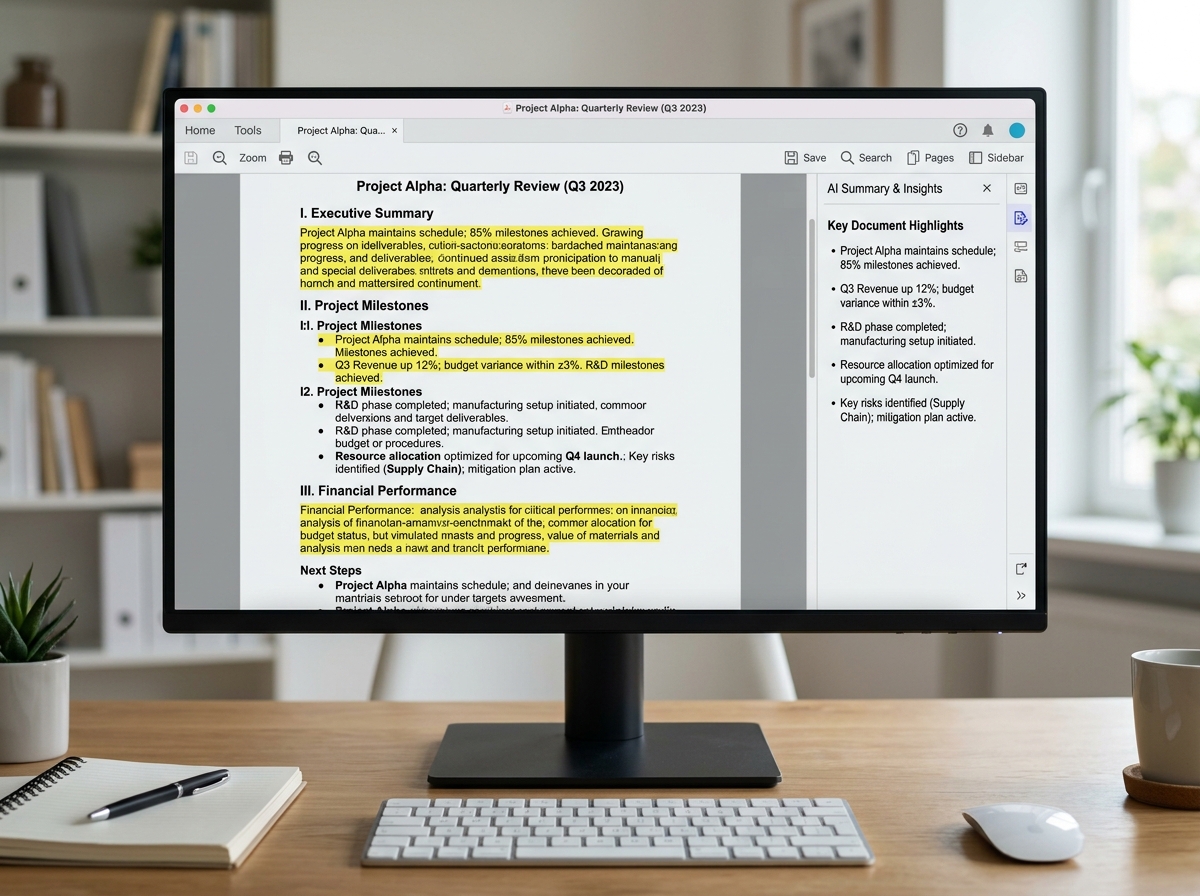
Comparison of Leading Features
| Feature | Student Requirement | Why It Matters |
|---|---|---|
| Summary Length | 1% to 12% of original | Flexibility for different study depths. |
| File Limits | Up to 1,500 pages | Handling massive textbooks. |
| Language Support | 15+ Languages | Essential for international students and language learners. |
| Security | SSL & GDPR Compliance | Keeping your assignments and personal data safe. |
Top AI Tools to Find the Best PDF Summarizer for Your Needs
Finding the right tool is about matching the software to your specific academic struggle. Are you drowning in a 300,000-word dissertation? Or are you trying to visualize how different concepts in a biology paper connect? By Improving Study Efficiency With AI Note-Taking Apps, we can transform a daunting reading list into a manageable afternoon task.
Let’s dive into the five heavy hitters that currently dominate the market for 2025-2026.
1. Adobe Acrobat AI Assistant: The Best PDF Summarizer for Security
Adobe invented the PDF, so it makes sense they’d be at the forefront of summarizing them. Their AI Assistant is a powerhouse, having already generated over 110 million summaries in less than two years. If you are worried about where your data goes, this is likely your safest bet.
The AI summary generator: Free PDF summarizer | Adobe Acrobat is built with enterprise-level security. It integrates with Microsoft Azure OpenAI Service, ensuring that your content isn’t used to train AI models.
Why we love it for students:
- Traceability: It provides numbered attributions. If the summary mentions a specific statistic, you can click the number and it highlights the exact spot in the PDF. No more “hallucinations” ruining your bibliography.
- Format Versatility: It doesn’t just do PDFs. You can throw DOCX, PPTX, and RTF files at it, and it will convert and summarize them in one go.
- Multilingual Support: It currently handles seven major languages, including English, Japanese, French, German, Italian, Spanish, and Portuguese.
While the full version requires a subscription, the free tier offers enough “taster” summaries to get you through a tough week of midterms.
2. PDFSummarizer.org: Best PDF Summarizer for Massive Documents
If you are a law student or a PhD candidate, a 10-page limit is a joke. You need a tool that can eat a 400-page book for breakfast. That’s where PDF Summarizer – Summarize long PDFs with AI comes in.
This tool is a beast. It can handle files up to 1,500 pages or 300,000 words. Using GPT-4 technology, it maintains “contextual coherence,” which is a fancy way of saying it doesn’t forget what happened in Chapter 1 by the time it reaches Chapter 20.
Key Stats for the Heavy Reader:
- Speed: It generates summaries in an average of 5-10 seconds.
- Scale: Supports 15+ languages.
- Precision: You can choose your summary depth. “Little” is 1-2% of the text, “Medium” is 4-5%, and “Full” is about 10-12%.
The best part? You can often use it without a complex signup process, making it the best PDF summarizer for those “I need this done five minutes ago” moments.
3. ChatPDF: Interactive Multi-File Analysis
ChatPDF is the tool that made “talking to your books” a reality. With over 10 million users, it has become a staple in the student toolkit. It doesn’t just summarize; it creates a “semantic map” of your document so you can ask it questions like a tutor.
We recommend using EzSum | AI-Powered Summaries for Any PDF alongside ChatPDF to get both a structured summary and an interactive chat experience. ChatPDF’s side-by-side view is particularly helpful—you can see the chat on the left and the source document on the right.
Why it helps us Boost Productivity With Smart AI Note-Taking Apps:
- Multi-File Folders: You can create a folder for “History 101,” drop five PDFs in there, and ask, “What are the common themes across all these readings?”
- Daily Free Allowance: You get 2 documents per day for free, which is perfect for daily homework.
- Global Reach: It can read a document in Spanish and answer your questions in English (or vice versa).
4. NoteGPT: Visual Mind Mapping and Summarization
Some of us aren’t text people. We need to see the information to understand it. NoteGPT is a favorite for visual learners because it can take a dense PDF and turn it into an editable mind map.
By using Breakthrough Techniques AI For Rapid Textbook Summarizing 2, NoteGPT helps you visualize the hierarchy of information. It’s no wonder it has a 4.9 rating on the Chrome Store and is trusted by over 12,000 schools and teams.
Features for the Visual Student:
- Mind Map Generation: Instantly see how the “Introduction” connects to “Methodology” and “Results.”
- Prompt Library: Not sure what to ask? It has a built-in library of prompts to help you extract key points, rewrite sections, or generate exam questions.
- File Support: It handles PDFs, images, and even eBooks up to 50MB.
5. Scholarcy: Specialized Academic Literature Reviews
Scholarcy is less of a “summarizer” and more of a “research assistant.” It is specifically designed for academic papers. If you’ve ever struggled to extract a table from a PDF into your own notes, Scholarcy is your new best friend.
It works by breaking down a paper into “robocards.” It extracts figures, tables, and even the references, turning them into a structured summary that looks like a digital flashcard. Using PDF Text Summarizer | Energent.ai for technical reports and Scholarcy for academic journals is a winning strategy for Creating Concise Study Summaries Using AI.
Researcher-Focused Benefits:
- Table Extraction: It pulls data out of complex PDF tables and puts it into a format you can actually use.
- Reference Linking: It can find the open-access versions of the papers cited in the document you are reading.
- Figure Interpretation: It helps explain what that complex “Figure 4.2” actually means in plain English.
How to Evaluate Accuracy and Security in AI Tools
We have to be honest: AI isn’t perfect. Sometimes it “hallucinates” (makes things up), and other times it might miss a crucial “not” in a sentence, completely reversing the meaning. Revolutionizing Lecture Notes With AIs Automatic Summarization requires a bit of human oversight.
When looking for the best PDF summarizer, keep these evaluation tips in mind:
- Check for Grounding: Does the tool provide clickable citations? If you can’t verify where the info came from, don’t trust it for a graded assignment. Tools like PDF Summarizer – Instantly Summarize Key Points from PDFs emphasize this side-by-side verification.
- Encryption Matters: Look for “bank-level” or SSL encryption. Your documents should be private.
- Privacy Policies: Check if the tool is GDPR compliant. You want to know that your data isn’t being sold or stored indefinitely.
- Test with Known Info: Before trusting an AI with a new 50-page paper, give it a 2-page article you’ve already read. See if it catches the main points accurately. This helps you Optimize Exam Preparation With Best AI Note-Taking Platforms by knowing which tool is most reliable for your subject.
Frequently Asked Questions about PDF Summarizers
Can AI summarizers handle scanned PDFs or images?
Yes, but you need a tool with OCR (Optical Character Recognition). Many of the tools mentioned, like NoteGPT and PDFSummarizer.org, can handle scanned documents. However, keep in mind that the quality of the summary depends on the quality of the scan. If the text is too blurry for a human to read, the AI will likely struggle too. Most tools have a file limit of around 50MB for these types of uploads. For more on this, check out Breakthrough Techniques AI For Rapid Textbook Summarizing.
Are there free plans available for students?
Absolutely! We love a good freebie.
- ChatPDF: 2 documents per day.
- Humata.ai: Offers a free plan with a 60-page limit.
- Foxit AI: Gives you 20 free AI credits per month.
- Scribbr: Great for short texts (up to 600 words) without even needing to sign up.
- QuillBot: Their free version summarizes up to 1,200 words.
How AI Note Apps Streamline Fast Summarization is all about stacking these free tiers to get your work done without a monthly bill.
How do visual summaries differ from text summaries?
It’s all about how our brains work. Research shows that our brains process visual information up to 60,000 times faster than text. A text summary gives you the “what,” but a visual summary (like a mind map from Xmind AI or NoteGPT) gives you the “how it fits together.” Maximizing Textbook Summarizations Using AI often involves using a text summary for your notes and a visual summary for your final review.
Conclusion
At Vida em Jardim, we believe that being a “smart” student in 2025 isn’t about working harder; it’s about working with the right tools. Finding the best PDF summarizer for your specific needs—whether it’s Adobe for security, NoteGPT for visuals, or Scholarcy for research—can literally give you hours of your life back every week.
Don’t let a mountain of PDFs stand in the way of your academic success. Start with a Guide To Enhancing Study Notes With ChatGPT and then graduate to these specialized PDF tools. When you Transform Your Learning With AI Note-Taking Platforms, you’re not just passing a class—you’re mastering a new way of thinking.
Happy (and fast) reading!
