
Why Most Students Study Hard But Still Underperform (And How AI Changes That)
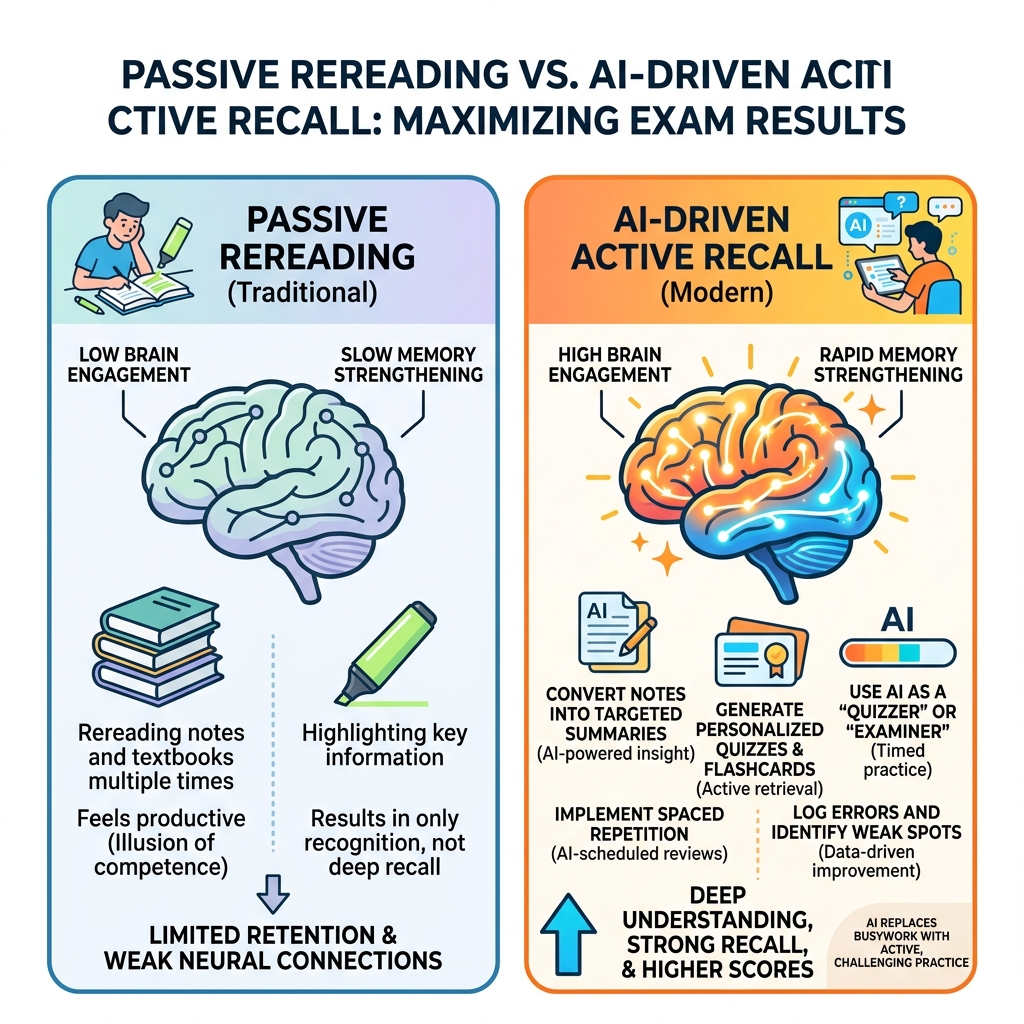
Exam revision AI strategies are methods that use artificial intelligence tools to replace passive study habits — like rereading notes — with active, evidence-backed techniques that build real, lasting memory.
Here are the core AI-powered revision strategies at a glance:
- Convert your notes into targeted summaries using tools like NotebookLM or ChatGPT
- Generate personalized quizzes and flashcards from your own study materials
- Use AI as a “Quizzer” or “Examiner” to simulate real exam pressure
- Implement spaced repetition with AI-scheduled review intervals
- Log errors and let AI identify your weak spots for smarter, targeted practice
- Interleave topics in daily revision blocks to strengthen memory connections
- Simulate oral exams or timed tests with AI to reduce test anxiety
You’re juggling lectures, deadlines, a social life, and maybe a part-time job. Revision time is tight. The last thing you need is to spend three hours highlighting a textbook and walk away remembering almost none of it.
Here’s the uncomfortable truth: how you study matters far more than how long you study.
Research published in Psychological Science found that students who practiced retrieval practice — actively pulling information from memory — remembered 50% more than students who simply re-studied the same material. Another study in the Journal of Educational Psychology found retrieval practice led to 23% higher final exam scores.
Yet most students still default to rereading, summarizing, and highlighting. It feels productive. It just doesn’t work.
That’s exactly where AI comes in. Not to do the learning for you — but to replace the busywork and set up the kind of active, challenging practice your brain actually needs to retain information under pressure.
The Science of Learning: Why Passive Revision Fails
We’ve all been there: sitting in the library for six hours, yellow highlighter in hand, feeling like a genius because the page is glowing. But when the exam paper lands on the desk, our minds go blank. This is what psychologists call the “illusion of competence.” Because the information looks familiar on the page, we mistake recognition for recall.
Traditional methods like rote learning (memorizing by simple repetition) and passive rereading fail because they don’t create “desirable difficulty.” To build a strong neural pathway, your brain needs to struggle a little. It needs to work to pull that fact out of storage.
According to cognitive science, three principles consistently outperform everything else:
- Active Recall: Testing yourself instead of just looking at the answer.
- Spaced Repetition: Reviewing material at increasing intervals (1 day, 4 days, 7 days) to interrupt the “forgetting curve”.
- Interleaving: Mixing up different topics in one study session so your brain learns to distinguish between them.
AI is the ultimate “force multiplier” for these principles. Instead of manually tracking when you last studied photosynthesis, AI tools can automate the entire schedule. By demystifying exam preparation with AI, we can move away from “comfortable” studying that leads to poor test performance and embrace the “productive struggle” that leads to A-grades.
Master Your Materials: Converting Notes into Exam-Ready Assets
The biggest hurdle to starting revision is often the sheer volume of “stuff.” You have 60 pages of messy handwritten notes, five slide decks, and a 400-page textbook. Where do you even begin?
We recommend a “centralize and condense” approach using AI.
Step 1: Digital Conversion
If your notes are physical, don’t waste hours re-typing them. Use Google Lens or the OCR (Optical Character Recognition) features in ChatGPT/Claude to snap a photo and turn it into digital text instantly.
Step 2: Concept Hierarchy (The Tier System)
Not all information is created equal. When you optimize exam preparation with best AI note-taking platforms, you can ask the AI to categorize your material into three tiers:
- Tier 1: Concepts that appear on almost every past exam (High Priority).
- Tier 2: Concepts that are often tested (Medium Priority).
- Tier 3: Niche details that rarely appear (Low Priority).
Step 3: Prompt Engineering for Clarity
Once your notes are digital, use specific prompts to transform them. Don’t just ask for a “summary.” Try the Feynman Technique prompt: “Explain [Topic] like I’m 5 years old, using a real-world analogy. Then, ask me three questions to see if I understood.”
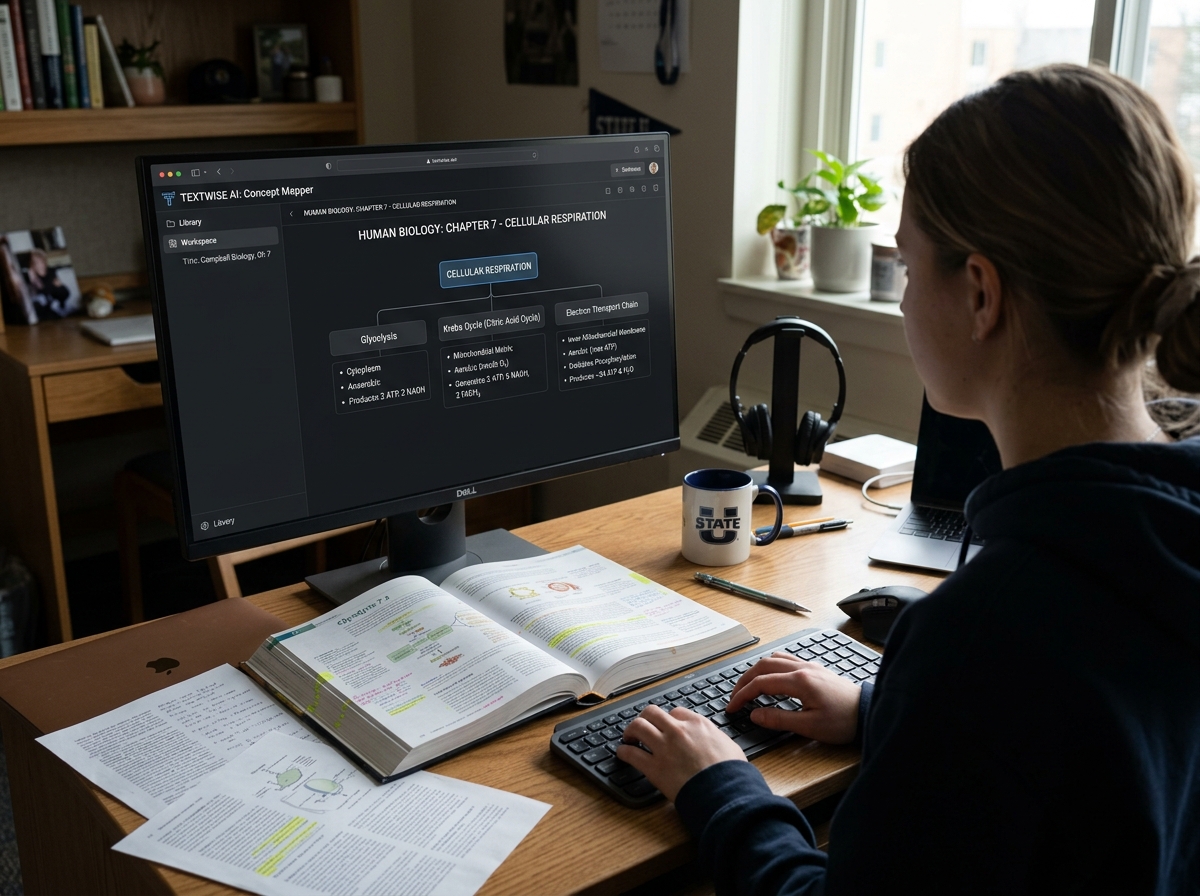
Using tools like NotebookLM, you can upload your specific lecture slides and ask it to generate a study guide only based on those sources. This prevents the AI from “hallucinating” or bringing in outside info that your professor hasn’t covered. This is one of the most effective using-ai-note-taking-tools-to-ace-your-exams/ strategies because it keeps your revision laser-focused on what will actually be on the test.
Implementing High-Impact Exam Revision AI Strategies
To see real results, you need a system, not just a tool. Students using structured study systems show 67% better retention compared to traditional note-taking. We’ve designed a 14-day roadmap that combines AI efficiency with cognitive science.
| Day | Traditional Plan | AI-Powered 14-Day Plan |
|---|---|---|
| 1-3 | Read chapters 1-5 | Diagnostic Testing: Upload notes to AI; generate a 30-question “pre-test” to find weak spots. |
| 4-7 | Highlight and summarize | Active Synthesis: Turn weak spots into AI-generated flashcards (Anki/Gizmo) and “Explain like I’m 5” notes. |
| 8-11 | Reread summaries | Spaced Practice: 25-min Pomodoro blocks focusing only on the “Red Zone” topics identified by AI. |
| 12-13 | Cram everything | Exam Simulation: Use AI as an “Examiner” for a timed, 60-minute mock test. |
| 14 | Panic and coffee | Final Review: Log errors from the mock test and do a 15-minute “Rapid Fire” recall drill with AI. |
The Power of the Error Log
One of our favorite smart-planning-tips-for-exam-prep/ is the AI-Enhanced Error Log. Every time you get a practice question wrong, paste your incorrect answer into the AI. Ask: “What misconception does this answer reveal, and can you give me a step-by-step worked example of the correct reasoning?” This turns a failure into a data point for growth.
Subject-Specific Exam Revision AI Strategies
AI isn’t a one-size-fits-all tool. You should adapt your exam revision AI strategies based on what you’re studying:
- Mathematics: Ask AI to generate “graduated problem sets.” Start with basic procedural questions and ask it to increase the complexity to multi-step “exam-style” problems only after you get the first three right.
- Sciences: Use “What-if” scenarios. “What if the concentration of CO2 was doubled in this photosynthesis experiment? How would the graph change?” This tests deep conceptual understanding rather than just memorizing labels.
- Humanities: Ask the AI to play “Devil’s Advocate.” If you’re writing an essay plan on the causes of the French Revolution, ask: “Give me three strong counter-arguments to my thesis and suggest primary sources that would support them.”
- Languages: Use the voice mode on ChatGPT or Claude as a conversation partner. Set a scenario: “We are at a French bakery. You are the baker, and I am a difficult customer. Correct my grammar as we go.”
Tracking Progress with Exam Revision AI Strategies
The secret to staying motivated is seeing progress. Most students feel like they’re drowning in a sea of information. AI helps by providing adaptive learning paths. By tracking your scores on AI-generated quizzes, you can see a heatmap of your knowledge. If you’re scoring 95% on “Cell Biology” but 40% on “Genetics,” the AI will automatically reallocate your study time to the weak areas. This strategic time allocation ensures you aren’t wasting time on what you already know.
Advanced AI Simulation and Ethical Safeguards
As we get closer to exam day, the goal shifts from learning to performing. Test anxiety often stems from the “fear of the unknown.” AI can solve this by simulating the exact environment you’ll face.
Oral Exam and Viva Prep
For students facing oral exams or presentations, AI is a lifesaver. You can use an AI avatar or voice tool to act as a “tough examiner.” Prompt: “I want you to act as a senior professor. I will explain my thesis, and I want you to interrupt me with challenging questions, focusing on my methodology. Be critical but fair.” This reduces anxiety by making the real thing feel like a “second take.”
AI-Resistant Question Design (A Tip for the Wise)
It’s important to know that professors are also using AI to make exams harder. They are moving toward “shaded evidence” questions. Instead of simple True/False (which AI can solve easily), they ask you to choose the strongest piece of evidence from four plausible options.
To prepare for this, when you are preparing-for-exams-with-ai-tools-a-tutorial/, ask the AI to generate “highly similar distractors” for your multiple-choice questions. This forces you to learn the nuances, making you “AI-resistant” yourself!
Avoiding the Pitfalls: Integrity and Accuracy
While we love innovation-in-education-ai-for-efficient-revision/, we have to be smart about it.
- Cognitive Offloading: Don’t let the AI do the thinking. If you ask it to summarize a chapter and you just read the summary without looking at the original text, you won’t learn. Use the AI to check your work, not replace it.
- Fact-Checking: AI can “hallucinate” (make things up confidently). Always cross-reference AI-generated facts with your official textbook or lecture notes.
- Academic Integrity: Use AI to generate study tools (flashcards, quizzes, schedules). Never use it to write assignments or take online exams. The goal is to build your brain, not a chatbot’s database.
Frequently Asked Questions about AI Revision
Is using AI for exam revision considered cheating?
Absolutely not. Using AI to generate flashcards, practice questions, or study schedules from your own materials is a modern study technique. It’s no different than using a store-bought study guide or a tutor. It only becomes cheating if you use it to produce work that you claim is your own for an assessment.
What is the best AI tool for generating practice quizzes?
For most students, NotebookLM is currently the gold standard because it allows you to upload your specific course materials as sources. This ensures the quizzes are relevant to your syllabus. Gizmo and Anki are also fantastic for turning those questions into long-term flashcards.
How early should I start using AI strategies before my finals?
Ideally, you should start 2–3 weeks before the exam. This gives you enough time to go through at least three cycles of spaced repetition. However, even if you only have 48 hours, AI can help you “triage” your notes by identifying the Tier 1 concepts you need to focus on to pass.
Conclusion
At Vida em Jardim, we believe that every student has the potential to excel — they just need the right system. Exam revision AI strategies aren’t about taking shortcuts; they’re about working with your brain’s natural learning processes instead of against them.
By using AI to automate the boring parts of revision — the organizing, the scheduling, and the note-summarizing — you free up your mental energy for the part that actually counts: active retrieval.
Don’t let exam season burn you out. Start small. Upload one set of notes today, ask for a 5-question quiz, and feel the difference that “productive struggle” makes. You’ve got the tools; now go crush those exams.
For more productivity tips and AI-powered study systems, visit us at https://vidaemjardim.com/.
