
Why Almost Everyone Procrastinates (And What You Can Actually Do About It)
If you want to know how to stop procrastination, here is a quick answer:
- Identify your smallest next action – break the task down to one tiny, doable step
- Start with just 2 minutes – commit to working for only two minutes to build momentum
- Remove distractions first – put your phone away and close unnecessary tabs
- Use the “Nothing Alternative” – either work on your task or do absolutely nothing else
- Forgive yourself – self-criticism makes procrastination worse, not better
Up to 95% of people procrastinate to some degree. So if you are reading this while avoiding a deadline, you are in very good company.
The ancient Greeks even had a word for it: Akrasia – acting against your own better judgment. Like choosing a donut when you are trying to eat healthy. You know what you should do. You just do not do it.
Here is why that happens. Your Present Self wants comfort right now. Your Future Self wants the essay done, the exam passed, the project finished. These two are constantly fighting – and Present Self usually wins in the moment.
The good news? Procrastination is not about being lazy or lacking willpower. Research consistently shows it is an emotion management problem, not a time management one. You avoid tasks because they trigger anxiety, fear of failure, or overwhelm – not because you are a bad student.
Understanding that changes everything.
Understanding the Psychology: Why We Struggle with how to stop procrastination
To truly master how to stop procrastination, we have to look under the hood of our own brains. Most of us think we delay tasks because we are disorganized, but the reality is more psychological. Procrastination is often a self-protection strategy.
When we face a daunting task—like a 20-page research paper or a complex coding project—our brain perceives it as a threat to our sense of ability. If we try our hardest and fail, it feels like a reflection of our intelligence. But if we procrastinate and then fail, we have a built-in excuse: “I just didn’t have enough time.” By delaying, we protect our ego from the judgment of our actual abilities.
This cycle is driven by several key psychological factors:
- Fear of Failure: The belief that if the result isn’t perfect, it’s a disaster.
- Perfectionism: Setting such high standards that starting feels impossible because we fear we won’t meet them.
- Poor Emotion Regulation: Choosing the immediate “mood repair” of a YouTube video over the long-term stress of a difficult assignment.
Procrastination vs. Laziness: Clearing the Confusion
We often hear people call themselves “lazy” because they cannot get started. However, there is a massive difference between the two. Laziness is passive apathy. A lazy person simply does not want to do the work and feels fine about not doing it.
Procrastination is an active choice. It is the act of choosing a more enjoyable, less important task over a high-priority one. Procrastinators often feel intense guilt, anxiety, and stress while they are avoiding their work. In fact, many procrastinators work incredibly hard—just at the wrong time or on the wrong things. Chronic procrastinators often have high levels of “evaluative anxiety,” meaning they care too much about the outcome, which leads to paralysis.
The Relevance and Comfort Framework
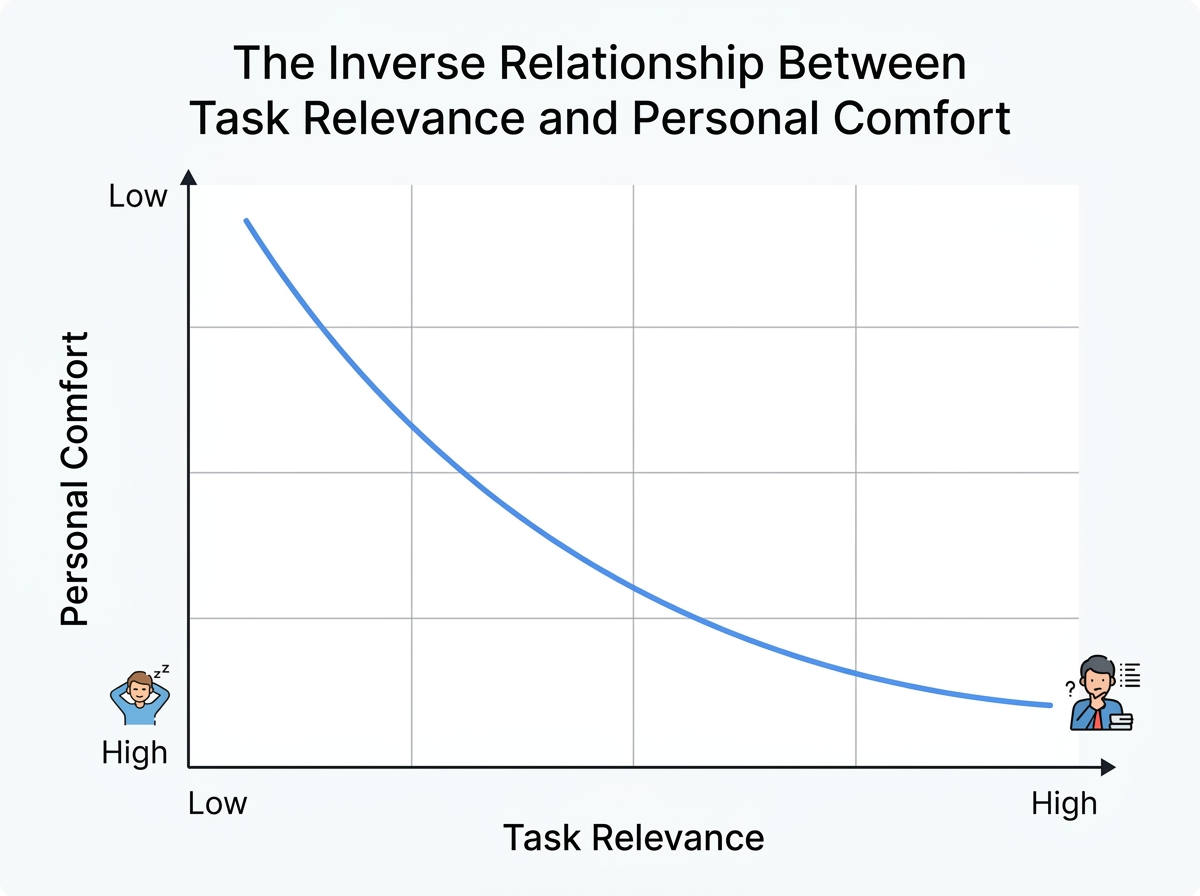
Most of us view productivity as a binary: you are either “working” or “procrastinating.” This mindset is often unhelpful because it leads to self-criticism. At Vida em Jardim, we prefer the Relevance and Comfort Framework.
Instead of asking “Why am I procrastinating?”, try asking two different questions:
- How relevant is this task to my goals?
- How comfortable am I doing this right now?
Sometimes, we choose “low-relevance, high-comfort” tasks (like color-coding a calendar) because we are avoiding the “high-relevance, low-comfort” task (actually writing the essay). To break through, we use the Magic Wand Question: “If I could wave a magic wand and instantly have one task finished, which one would it be?” That is your most relevant task. Once identified, your goal isn’t to force yourself into discomfort, but to find a way to make that relevant task just a little bit more comfortable.
Practical Strategies to Reclaim Your Time
Once we understand the “why,” we can move to the “how.” Learning how to stop procrastination requires a toolkit of actionable methods that trick the brain into starting.
The 2-Minute Rule
This is one of the most effective “gateway habits” ever created. The rule is simple: If a task takes less than two minutes, do it now. If a task is large, commit to doing just the first two minutes of it.
- Instead of “Study for finals,” the task becomes “Open my textbook to page one.”
- Instead of “Write a paper,” the task becomes “Write one sentence.” The goal is to master the habit of showing up. Once you start, the internal resistance usually vanishes.
The 5-Second Rule
Mel Robbins popularized this technique for overcoming hesitation. The moment you have an instinct to act on a goal, you must physically move within 5 seconds, or your brain will kill the idea. Count down: 5-4-3-2-1-GO. On “GO,” physically stand up or open your laptop. This interrupts the cycle of overthinking and forces the brain into action mode.
The Swiss Cheese Method
When a project feels like a giant, solid block of “NO,” use the Swiss Cheese method to punch holes in it. Spend 10 or 15 minutes doing a small, specific part of the task. You aren’t trying to finish the whole thing; you are just making the task “holy” (like Swiss cheese) by completing small chunks. Eventually, the task becomes so full of holes that it no longer feels intimidating.
Immediate Action: how to stop procrastination Right Now
To stop the spiral immediately, you need to “dumb down” your brain. Stop thinking about the “project” and identify the very next physical action. Not “do research,” but “click the Google Chrome icon.”
We also recommend leveraging modern technology to lower the barrier to entry. For example, using ai-techniques-to-avoid-procrastination can help you generate outlines or break down complex prompts, making the “starting” phase much less painful.
Using the “Nothing Alternative” to Build Momentum
The famous writer Raymond Chandler had a simple rule for his writing sessions: “Write, or do nothing at all.”
He didn’t force himself to write, but he forbade himself from doing anything else—no reading, no letters, no tidying. If you sit at your desk and give yourself the choice of “Work on the Calculus homework” or “Stare at the wall,” eventually, the homework starts to look a lot more interesting than the wall. This removes the “high-comfort” distractions and forces your brain to choose between boredom and productivity.
Long-Term Systems for Student Productivity
Short-term tricks are great, but long-term success comes from building an environment where procrastination struggles to survive.
Eat the Frog
Mark Twain once said that if you eat a live frog first thing in the morning, nothing worse will happen to you the rest of the day. Your “frog” is your hardest, most unpleasant task. Do it first thing in the morning when your willpower is highest. If you leave it for the evening, you will spend the whole day in a state of “dread-procrastination,” which drains your energy before you even start.
The Ivy Lee Method
This 100-year-old strategy is still used by peak performers today:
- At the end of each night, write down the six most important things you need to accomplish tomorrow.
- Rank them in order of true importance.
- Tomorrow, focus only on the first task until it is finished.
- Move to the second task. Repeat.
- At the end of the day, move any unfinished items to a new list of six for the next day.
Environment Design: Creating a Digital Fortress
Your environment often dictates your behavior. If your phone is next to you, you will check it. It is not a lack of willpower; it is just how our brains are wired for instant gratification.
| Productive Environment | Distracting Environment |
|---|---|
| Phone in another room or a drawer | Phone on the desk (even face down) |
| Noise-canceling headphones / Lo-fi music | TV on in the background / Lyric-heavy music |
| Specific “Work Only” location (Library/Desk) | Working in bed or on the couch |
| Browser tabs limited to the current task | 20+ open tabs including social media |
| Water and snacks already prepared | Getting up every 10 mins for “breaks” |
Optimizing Your Environment for Focus
- Phone Removal: This is the #1 tip for students. Put your phone in a different room. The mere presence of a smartphone reduces cognitive capacity.
- Lyric-Free Music: Use video game soundtracks or lo-fi beats. Lyrics engage the language-processing part of your brain, which you need for reading and writing.
- App Limits: Use tools like Cold Turkey or Forest to lock yourself out of distracting websites during study blocks.
Frequently Asked Questions about how to stop procrastination
Can procrastination ever be beneficial?
Believe it or not, yes. Active procrastination is when you intentionally delay a task to work under the pressure of a deadline, which some people find focuses their mind. There is also the Zeigarnik Effect, which suggests that our brains remember uncompleted tasks better than completed ones. By starting a task and then “procrastinating” (taking a break), your subconscious continues to work on the problem, often leading to creative “aha!” moments. However, this only works if you have already started the task.
When should I seek professional help for chronic procrastination?
If you find that you simply cannot stop procrastinating despite using every tip in the book, it might not be a habit issue. Chronic procrastination is often linked to underlying conditions like ADHD, anxiety, or depression. If your procrastination is leading to severe distress, loss of jobs, or failing grades, it is time to consult a healthcare professional. They can help you address the root emotional or neurological causes.
How do I stay motivated without burning out?
The secret is Temptation Bundling. Only allow yourself to do something you love while doing something you procrastinate on. (e.g., “I only listen to my favorite podcast while doing laundry.”)
Also, rest is a requirement, not a reward. If you don’t schedule time to play and sleep, your brain will “steal” that time through procrastination. Finally, practice self-forgiveness. Studies show that students who forgave themselves for procrastinating on the first exam actually procrastinated less on the second one. Guilt is a heavy burden that makes it harder to get moving.
Conclusion
At Vida em Jardim, we know that being a student today is harder than ever. You aren’t just fighting your own brain; you are fighting apps and platforms designed to steal your attention. That is why we focus on AI-powered productivity and tailored strategies that meet you where you are—whether you are struggling with a lab report or trying to balance your social life with finals.
Learning how to stop procrastination is a journey of self-discovery. It is about moving from a place of “I have to” to “I choose to.” Start small. Pick one “frog” to eat tomorrow morning. Put your phone in a drawer. Write one sentence.
You don’t have to be perfect to be productive. You just have to start.
For more practical tips on hacking your education and reclaiming your focus, check out More study hacks for students.
