
The Lazy Student’s Secret: What AI Study Flashcards Actually Are
AI study flashcards are digitally generated cards created automatically by artificial intelligence from your existing study materials — no manual card-writing required.
Here’s what you need to know at a glance:
- What they are: Flashcards generated by AI from your PDFs, notes, slides, or videos
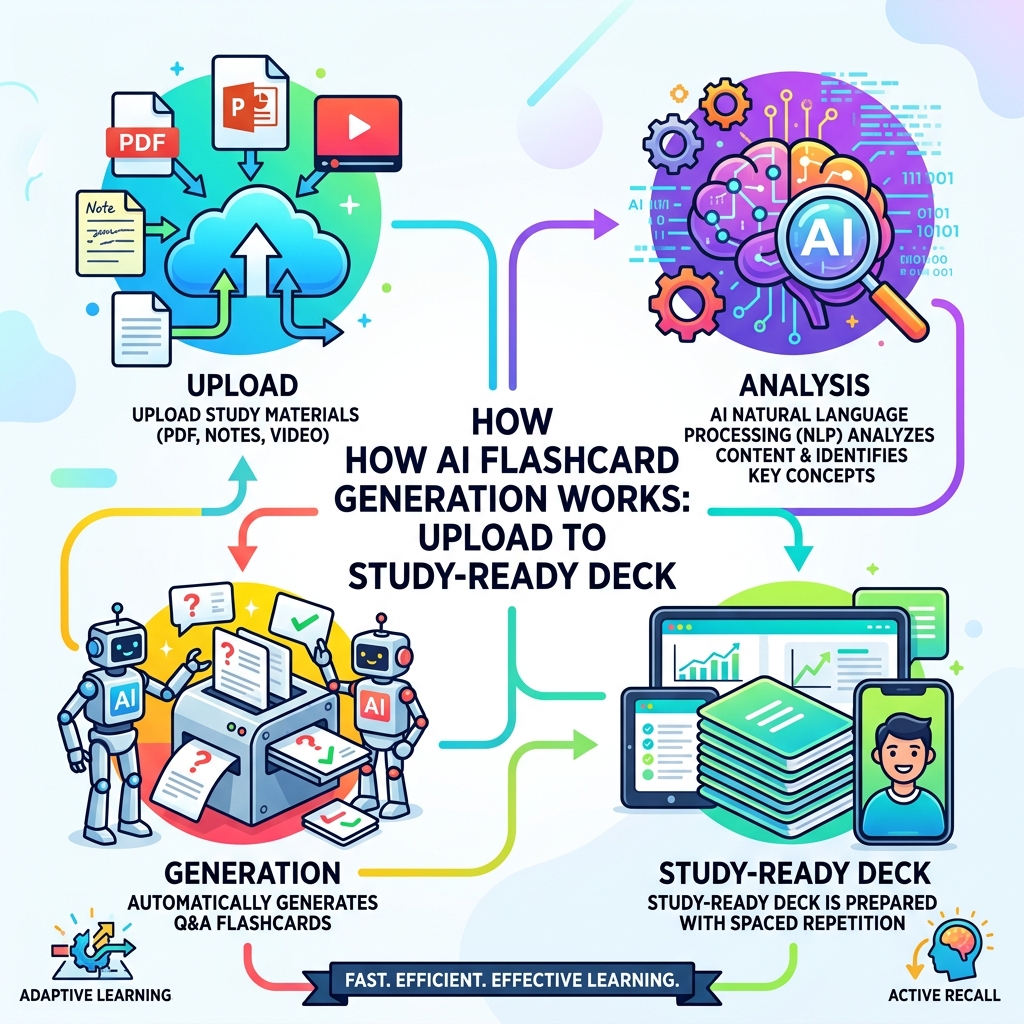
- How they work: AI reads your content, pulls out key concepts, and formats them into question-and-answer cards
- Why they matter: Studies suggest using flashcards before learning new material can improve retention by up to 30%
- Who they’re for: Students, language learners, professionals — anyone who needs to memorize information fast
- Popular input types: PDFs, PowerPoints, YouTube videos, images, handwritten notes, plain text
- Key features: Spaced repetition, adaptive learning, exam simulation, Anki export
If you’ve ever spent three hours making flashcards by hand — only to feel like you barely studied — you’re not alone. That’s the trap most students fall into. You put all your energy into making the study tools instead of actually using them.
AI flips that completely.
Tools powered by artificial intelligence can turn a 20-page lecture PDF into a ready-to-study flashcard deck in seconds. One student at the University of Miami described the questions generated from her lecture slides as “insanely good” — the kind of quality that used to take hours to create manually.
The technology behind this isn’t magic. It’s natural language processing — the same type of AI that powers chatbots and search engines — applied to your study content. It reads, understands, and restructures information into active recall format, which is one of the most effective learning methods known to cognitive science.
For a busy college student juggling deadlines, part-time work, and a social life, that’s a game-changer.
The Science of AI Study Flashcards: How They Work
At its core, ai study flashcards work by automating the most tedious part of the learning process: content extraction. Instead of you highlighting a textbook and then typing those highlights into a card, the AI uses Natural Language Processing (NLP) to identify what is actually important.

When we upload a document, the AI doesn’t just “copy and paste” text. It analyzes the hierarchy of the information. It looks for definitions, cause-and-effect relationships, and list-based data. Then, it applies the principles of active recall and retrieval learning.
Active recall is the practice of challenging your brain to retrieve information rather than just passively rereading it. By transforming your notes into a question-and-answer format, the AI forces your brain to work harder during the study session, which strengthens neural pathways.
Common Input Methods for AI Study Flashcards
One of the coolest things we’ve found in our research is the sheer variety of materials you can transform. You aren’t limited to just typing out text. Modern ai study flashcards platforms allow for:
- PDF and PowerPoint Conversion: Upload your entire lecture slide deck or a 50-page textbook chapter.
- YouTube Transcripts: Simply paste a URL from an educational video, and the AI will “watch” the video and pull out the key facts.
- Handwritten Notes: Using advanced image recognition (OCR), some tools can even read your messy lecture scribbles from a photo.
- Textbook Photos: If you have a physical book, you can snap a picture of the page and turn it into a study set in minutes.
- Multilingual Support: Many of these platforms work in over 50 languages. Whether you are studying in English, Spanish, or even Bengali, the AI can detect the language and generate cards accordingly.
Personalizing Your Learning with AI Study Flashcards
Traditional paper cards are static. They don’t know if you’re struggling with a specific concept. AI-powered tools, however, use adaptive algorithms.
These platforms often include confidence tracking, where you rate how well you knew an answer. This helps the AI detect the “illusion of mastery”—that dangerous feeling where you think you know a topic just because you recognize the words, even though you can’t actually recall the facts.
Furthermore, many platforms now offer AI tutoring. If you get a flashcard wrong, you can ask an integrated AI bot to explain the concept in simpler terms or provide a real-time analogy. This personalized feedback ensures you aren’t just memorizing words, but actually understanding the material.
Science-Backed Benefits: Why AI Flashcards Beat Manual Creation
We all want to study less and play more, right? The statistics behind AI-powered study tools are hard to ignore. Some platforms claim to make learning 10x faster, while others report that their users become exam-ready 3x faster than those using traditional methods.
Using ai study flashcards provides a significant 30% retention boost if used for pretesting—that is, looking at the cards before you even attend the lecture. This primes your brain to look for specific answers during the class.
To help you visualize the difference, we’ve put together a quick comparison:
| Feature | Manual Flashcards | AI Study Flashcards |
|---|---|---|
| Creation Time | Hours (Passive) | Seconds (Automated) |
| Organization | Physical clutter or manual folders | Auto-categorized and searchable |
| Learning Science | Basic repetition | Spaced Repetition & Active Recall |
| Multimedia | Text only (usually) | Images, Video transcripts, Audio |
| Personalization | None | Adaptive difficulty & AI Tutoring |
If you want to dive deeper into how technology changes the way we remember things, check out our guide on how to Empower Your Memory with AI-Based Techniques. We also have a breakdown of AI Tools to Reduce Study Time for those of us who really value our weekend freedom.
Efficiency for High-Stakes Exams
For students in demanding fields, the volume of information can be soul-crushing. This is where ai study flashcards truly shine. Whether it’s memorizing medical anatomy, complex legal terminology, or intricate engineering formulas, AI can process thousands of cards in seconds.
With over 1 million students already using these types of tools, the “lazy” method is becoming the “smart” method. For instance, medical residents use AI-generated cards to master pathophysiology, while language learners use them to acquire thousands of new words (like Kanji) in record time.
Advanced Features and Integration Options
The best ai study flashcards tools offer more than just a front-and-back card. They incorporate advanced cognitive science features that help you “hack” your brain’s memory limits.
One of the most important features is Spaced Repetition (SRS). This is a science-backed technique that schedules reviews at increasing intervals. If you get a card right, you see it less often; if you get it wrong, it appears more frequently. This ensures you are always studying at the edge of your knowledge.
Other advanced features include:
- Cloze Cards: These are “fill-in-the-blank” cards that are excellent for memorizing definitions or sentences.
- Image Occlusion: This is a lifesaver for STEM students. It allows the AI to block out parts of a diagram (like the labels on a heart diagram) so you can test your visual memory.
- Exam Simulation: Some tools offer an “exam mode” that provides timed recall sessions and fatigue modeling, simulating the pressure of a real test.
- AI Explanations: If a card is confusing, you can click a button to get a deeper AI-generated explanation of the answer.
For those of you ready to start building your own decks, we recommend following our AI Tutorial for Creating Study Flashcards. Once you have your decks, you can also learn how to Track and Review Study Materials with AI Tools to keep your progress on track.
Exporting and Collaboration
You don’t have to be tied to a single app. Most top-tier AI generators allow for Anki integration. Anki is the gold standard for long-term memorization, and being able to generate cards with AI and then export them to Anki gives you the best of both worlds.
Other export options typically include PDF export (for those who still like to print and study offline), shared libraries for group study sessions, and seamless mobile syncing so you can study on the bus or while waiting for coffee.
Potential Limitations and Ethical Considerations
While we love the efficiency of AI, we have to be realistic. AI isn’t perfect.
The biggest risk is hallucination. This is when the AI confidently generates a fact that is completely wrong. This usually happens if the source material is low-quality or if the AI misinterprets a complex sentence.
Here are some things we should keep in mind:
- Accuracy Checks: Always do a quick “sanity check” on your cards. If an answer looks weird, double-check it against your textbook.
- Human Review: The best study workflow is AI-generated, human-edited. Use the AI to do the heavy lifting, then spend five minutes refining the cards to match your personal understanding.
- Academic Integrity: Use these tools for learning and revision, not for cheating. Most schools encourage active recall tools, but always ensure you are following your institution’s specific policies.
- Over-reliance: Don’t let the AI do all the thinking. The goal is for you to learn the material, not for the AI to learn it for you!
For more on how to use these tools responsibly, see our article on Demystifying Exam Preparation with AI.
Frequently Asked Questions about AI Flashcards
Can AI flashcards be used for any subject?
Absolutely. While they are incredibly popular for STEM (Science, Technology, Engineering, Math) because of the heavy memorization involved, they are equally effective for the Humanities. AI can analyze literature for themes, summarize historical dates, or break down complex philosophical arguments into digestible cards. They are also widely used for professional certifications like the CPA, NCLEX, or bar exams.
Are there free options for AI flashcard generators?
Yes, most platforms operate on a freemium model.
- Free Tiers: Usually allow a certain number of character uploads (e.g., 25,000 characters) or a limited number of AI-generated decks per month.
- Paid Tiers: Unlock unlimited uploads, larger character limits (up to 150,000+), document uploading, and advanced export options.
If you’re just starting out, the free versions are usually more than enough to get through a few midterms!
How do I ensure the accuracy of AI-generated cards?
The best way to ensure accuracy is to provide high-quality source material. If you upload a clear, well-formatted PDF, the AI will perform much better than if you upload a blurry photo of a handwritten note. Many platforms also use semantic understanding, meaning they grade your answers based on the meaning rather than just the exact wording, which helps reduce errors during study sessions.
Conclusion
At Vida em Jardim, we believe that being a “lazy” student doesn’t mean doing nothing—it means being efficient. By using ai study flashcards, we can reclaim hours of our lives that would have been wasted on manual data entry.
Whether you are trying to ace a microbiology quiz, learn a new language, or just survive finals week with your sanity intact, AI is the ultimate study assistant. It takes the “chaos” of your lecture notes and turns it into structured, actionable knowledge.
Ready to level up? Master your study routine with our latest hacks and start studying smarter today. Happy learning!
