
Stop Procrastinating with the Ultimate Daily Study Planner App
Why Students Are Turning to Digital Study Planner Apps
The best study planner app for students helps you organize classes, track homework, manage exam prep, and reduce academic stress — all in one place. Here are the top options to consider:
| App | Best For | Free Plan? | Key Feature |
|---|---|---|---|
| MyStudyLife | All-round academic planning | Yes | Rotating timetables, Pomodoro timer |
| Shovel | Procrastination & workload management | Trial only | Cushion™ workload forecasting |
| AriaPlanner | AI-powered focus coaching | Trial only | Adaptive focus modes |
| Notion | All-in-one workspace | Yes | AI study guides, notes + tasks |
| Structured | Visual daily planning | Yes | Timeline-based daily view |
You’re juggling lectures, assignments, deadlines, a part-time job, and somehow a social life too. That’s a lot to hold in your head.
The problem isn’t effort. It’s the mental load. Trying to remember everything you need to do — and when — leaves less brain space for actually learning.
Research shows that students commonly struggle with three core issues:
- Procrastination — putting off tasks until panic sets in
- Missed deadlines — forgetting assignments or test dates
- Overwhelm — seeing a 30-page reading or a big essay as one giant block
A good study planner app doesn’t just act as a digital to-do list. It actively reduces the mental clutter so you can focus on what matters: understanding your coursework and doing well.
With over 24 million students now using dedicated planner apps like MyStudyLife, it’s clear that digital planning tools have moved from “nice to have” to essential.
In this guide, we break down the best study planner apps available right now, what features actually matter, and how to pick the right one for your situation.
Essential Features of a Modern Study Planner App
When we look for a study planner app for students, we aren’t just looking for a digital version of a paper diary. We need a tool that understands the unique rhythm of academic life. A standard calendar might remind you of a dentist appointment, but it won’t tell you that your Chemistry lab is on a “Day B” rotation or that you have three exams in the same week.
Class Scheduling and Homework Tracking
The backbone of any academic planner is the ability to handle complex timetables. Whether you are in high school or university, your schedule likely isn’t a simple Monday-to-Friday 9-to-5. You need an app that supports rotating schedules and block timing. Beyond just knowing where to be, you need to track what needs to be done. Top apps allow you to attach tasks directly to specific subjects, so when you look at your “History” folder, you see every reading, essay, and quiz associated with it.
Exam Reminders and Subtasks
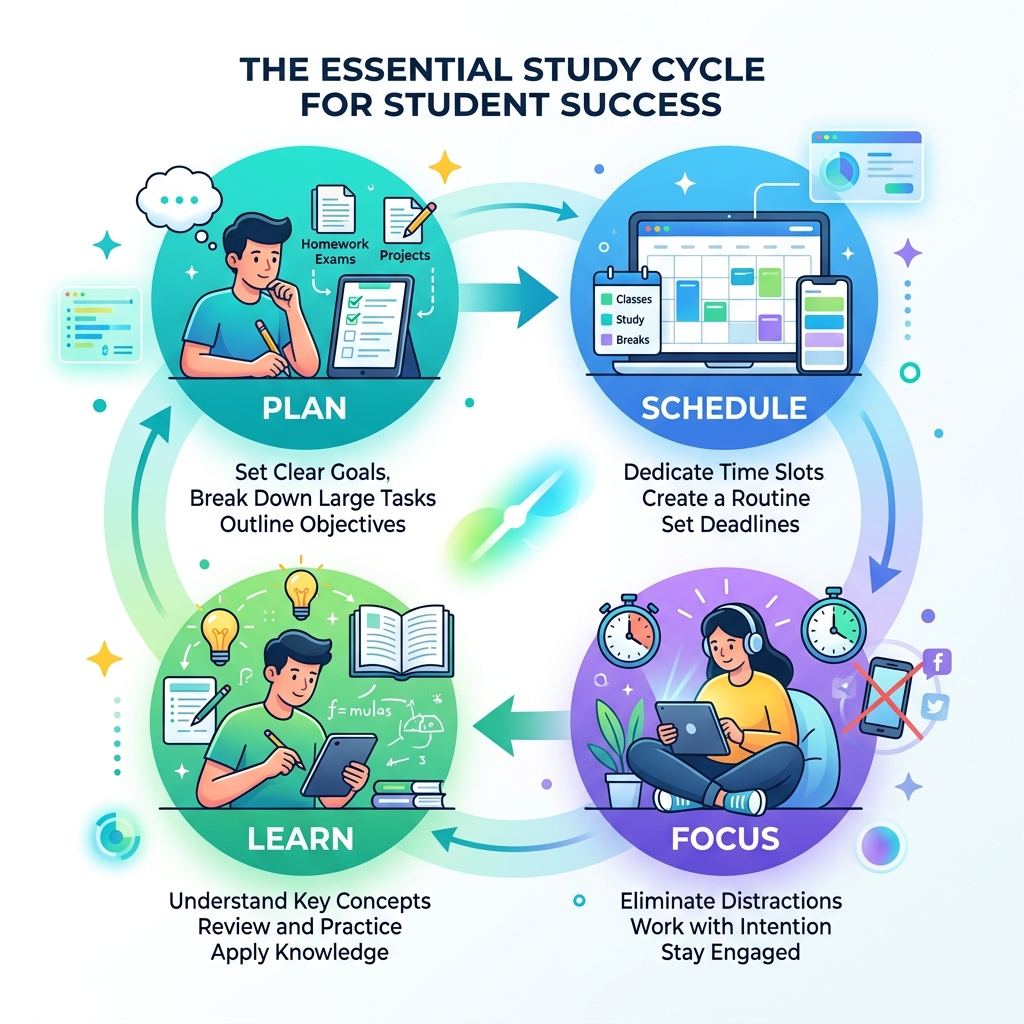
Looking at a massive 3,000-word essay as a single task is a recipe for anxiety. A great study planner app for students allows you to break these “monster tasks” into manageable subtasks. By checking off small steps—like “find five sources” or “write the introduction”—you build momentum and reduce the urge to procrastinate.
Integrated Focus Tools: The Pomodoro Timer
Focus is a finite resource. Many modern planners now include built-in Pomodoro timers. This technique involves studying for a set block (usually 25 minutes) followed by a short break. Having this integrated into your planner means you don’t have to switch between apps, which is often where distractions like social media creep in.

To get the most out of these features, it is vital to know how to set reminders for study tasks effectively. It’s not just about the “due date”; it’s about setting “do dates” that give you enough lead time to finish without pulling an all-nighter. If you are new to digital tools, we recommend setting up AI tools for academic productivity to automate the boring parts of organization.
Choosing Your Ideal Study Planner: Free vs. Paid Options
One of the biggest hurdles for students is the budget. Luckily, the market for a study planner app for students is diverse, ranging from completely free community favorites to premium power-user tools.
The Free Contenders
Apps like MyStudyLife have gained massive popularity (with over 5 million downloads on Google Play alone) because they offer a robust suite of features for free. You get cross-device sync, meaning you can add a task on your laptop during a lecture and see the reminder on your phone while on the bus. These apps are often “designed for students, by students,” focusing on the essential needs of a typical school year.
The Premium Powerhouses
Paid apps like Shovel or AriaPlanner usually operate on a subscription model, often costing between $9 and $20 per month. Why pay? These apps offer “intelligent” features that free versions lack. For example:
- Workload Forecasting: Seeing exactly how many hours of work you have versus how many hours of free time are actually in your day.
- Syllabus Integration: Some paid tools allow you to upload a PDF syllabus, which the app then scans to automatically create your entire semester’s schedule.
- Parent Portals: For K-12 students, some premium versions offer a way for parents to view schedules and overdue tasks without micromanaging the student’s daily flow.
Cross-Device Sync and Reliability
A planner is only useful if it’s with you. If you log an assignment on your Mac but can’t see it on your Android phone, the system breaks down. When choosing, check user reviews for mentions of “data loss” or “sync issues.” While apps like Daily Study offer great Mac-specific features like AI handwriting-to-text conversion, make sure it fits into your entire hardware ecosystem.
How AI-Powered Features are Revolutionizing Academic Productivity
We are entering the era of the “smart” planner. AI is no longer just a buzzword; it is actively helping students reclaim their weekends.
Syllabus Upload and AI Schedule Scan
The most tedious part of the semester is the first week—manually entering every deadline from five different syllabi. New AI features allow you to simply take a photo of your schedule or upload a PDF. The AI identifies dates, task types, and weightings, populating your calendar in seconds. This is a game-changer for reducing the initial friction of getting organized.
Turning “Due Dates” into “Do Dates”
Procrastination often happens because we don’t know when to start. AI-powered planners like Shovel use “Cushion™” technology. This calculates the time required for each task and compares it to your available “time health.” If you have a massive project due Friday but your Wednesday and Thursday are packed with classes, the AI will warn you on Monday that you are running out of time.
Adaptive Focus and Energy Mapping
Apps like AriaPlanner act as an AI focus coach. Instead of a rigid schedule, they adapt to your energy levels. If the AI learns that you are most productive in the mornings, it will suggest your hardest tasks for that window. This level of streamlining study schedules with AI automation ensures you aren’t fighting your own biology while trying to study.
Choosing the Right Tool for Complex Schedules and School Systems
Not every student has a standard 1st-period through 8th-period day. Some school systems use highly complex rotations that can make traditional planners useless.
Rotating Timetables and Block Schedules
If your school uses a Day A/Day B or a Week 1/Week 2 system, you need a study planner app for students that supports cyclical scheduling. My Study Life is a leader here, allowing for custom rotations that shift daily. This ensures that when you open your app on a Tuesday, you see the correct classes for that specific “Day B,” not just a generic Tuesday schedule.
Extracurricular and “Xtra” Tracking
Academic success doesn’t happen in a vacuum. You likely have sports practice, club meetings, or a part-time job. Apps that include an “Xtra” or “Personal” section allow you to see your whole life in one view. This prevents the common mistake of scheduling a deep-focus study session at the exact same time you have a soccer match.
School-Focused vs. Personal Apps
There is a distinction between apps you use for yourself and those adopted by school districts.
- Personal Apps (like MyStudyLife or Notion): These focus on your individual productivity and notes.
- School-Integrated Apps (like myHomework): These often include administrative features like digital hall passes, violation tracking (for tardiness or dress code), and direct LMS (Learning Management System) integration. While these are great for accountability, they focus more on “movement management” than personal study habits.
For those preparing for major milestones, we recommend checking out smart planning tips for exam prep to see how to integrate these complex schedules into a winning revision strategy.
Frequently Asked Questions about Student Planners
What is the best free study planner app for students?
For most students, MyStudyLife is the top free choice. It offers a comprehensive suite of tools—including rotating timetables, exam tracking, and cross-platform sync—without a subscription fee. If you prefer a visual, timeline-based approach, Structured is an excellent free alternative that helps you block out your day hour-by-hour. For those who need a workspace that handles both notes and tasks, Notion provides a powerful free tier for students.
Can a study planner app for students handle rotating timetables?
Yes, but you must choose an app specifically designed for academics. Standard apps like Google Calendar often struggle with Day A/B or Week 1/2 cycles. Apps like My Study Life allow you to input your school’s specific rotation. You can even use “AI Schedule Scan” features in some premium versions to take a photo of your paper timetable and have the app automatically figure out the rotation for you.
How do AI features reduce academic procrastination?
AI reduces procrastination by removing “decision fatigue.” Instead of staring at a long list of tasks and wondering what to do first, AI analyzes your deadlines, task complexity, and energy levels to tell you exactly what to work on now. By turning “Due Dates” into actionable “Do Dates” and providing a “Cushion” of safety, these apps stop the “panic-mode” cycle and replace it with a steady, manageable workflow.
Conclusion
Mastering your time is the single most important skill you can develop in school. A study planner app for students is no longer just a luxury—it’s a vital partner in your academic journey. Whether you choose the robust, free features of MyStudyLife or the cutting-edge AI coaching of AriaPlanner, the goal remains the same: reducing stress and improving focus.
At Vida em Jardim, we believe that by using AI-powered strategies, you can stop fighting against your schedule and start making it work for you. By automating the organization process, you free up your mental energy for what truly matters—learning, growing, and enjoying your student years.
Ready to take your productivity to the next level? Master your schedule with our latest study hacks and discover how to turn academic chaos into a clear path toward success.
