
AI Confidence Building Exercises Are the Skill Gap You Didn’t Know You Had
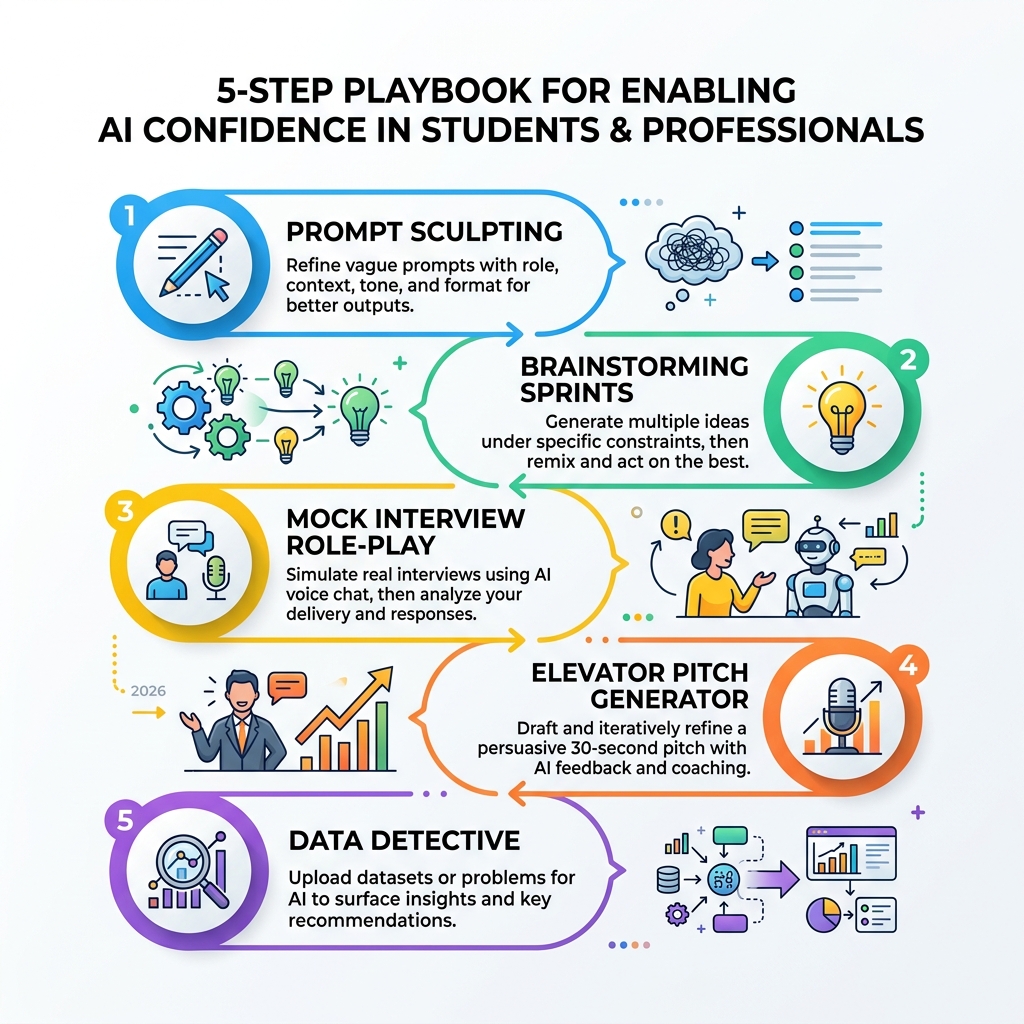
AI confidence building exercises are hands-on practices that help you move from feeling intimidated by AI tools to using them fluently, strategically, and daily. Here’s a quick overview of the most effective ones:
- Prompt Sculpting – Refine vague prompts by adding role, context, tone, and format until AI outputs improve dramatically
- Brainstorming Sprints – Ask AI for 10 ideas under specific constraints, then remix and act on the best one
- Mock Interview Role-Play – Use AI voice chat to simulate interviews, then analyze your delivery
- Elevator Pitch Generator – Draft and iteratively refine a 30-second pitch with AI feedback
- Data Detective – Upload a dataset or problem and ask AI to surface insights and recommendations
- AI as Confidence Coach – Use structured prompts to tackle self-doubt, limiting beliefs, and social anxiety
You already juggle lectures, deadlines, part-time work, and a social life. AI tools should make that easier. But for most students, they don’t — at least not yet.
The problem isn’t the technology. It’s confidence.
Research shows that people’s reactions to AI range from early adoption to outright fear. Most of us fall somewhere in the messy middle: curious, but unsure where to start. That uncertainty leads to passive use — copying an AI answer here, asking a quick question there — without ever building real fluency.
Here’s what’s at stake: the World Economic Forum’s Future of Jobs Report 2025 projects that AI could generate 170 million new jobs worldwide by 2030. The students who thrive won’t be the ones who feared AI the longest. They’ll be the ones who practiced.
The good news? Confidence isn’t built by reading about AI. It’s built by doing — through structured, repeatable exercises that get easier every time.
“Like Rome, AI confidence isn’t built in a day.” But it is built — through practice, feedback, and a little courage to experiment.
Why AI Confidence is the New Essential Skill for Students

In the modern academic and professional landscape, AI is no longer a futuristic concept—it is a present-day coworker. But why is “confidence” the specific metric we should care about? Because confidence dictates usage. When we feel unsure of a tool, we use it tentatively, or worse, we use it incorrectly and lose trust when it “hallucinates” or gives a generic answer.
The World Economic Forum’s Future of Jobs Report 2025 highlights a massive shift: while some roles may automate, 170 million new jobs could emerge by 2030. These roles won’t just require “knowing” AI; they will require the ability to steer it. This is where the “AI Learning Loop” comes in. By engaging in ai confidence building exercises, we create a cycle where practice leads to experimentation, which leads to shared lessons, and finally, widespread mastery.
However, building this trust isn’t just about clicking buttons. According to research in Learning to Trust: How Humans Mentally Recalibrate AI Confidence Signals, humans actually have the cognitive ability to “recalibrate” how much they trust an AI based on experience. We aren’t stuck with our initial skepticism. We can learn when to lean on the AI and when to apply our own human judgment.
For students, this translates directly to academic success. Whether you are looking to empower your memory with ai based techniques or simply manage a heavy course load, the difference lies in being an active driver rather than a passive passenger.
| Feature | Passive AI Observation | Active Hands-on Exercises |
|---|---|---|
| Engagement | Low; watching tutorials | High; solving real problems |
| Retention | Short-term; “I forgot how to do that” | Long-term; “I’ve mastered this workflow” |
| Trust | Fragile; broken by one error | Calibrated; understanding AI limits |
| Career Edge | General awareness | Proven AI literacy and fluency |
5 Practical AI Confidence Building Exercises for Daily Mastery
We believe the fastest way to build AI confidence is through “gamified” practice. You don’t need a computer science degree; you just need curiosity. Here are five exercises you can start today to transform your relationship with generative AI.
- The Brainstorming Sprint: Instead of staring at a blank page for your next essay or project, give the AI a strict set of constraints. Ask for 10 ideas for a marketing campaign with a $0 budget, or 10 unique angles for a history paper on the Industrial Revolution. The goal isn’t to pick one and copy it; it’s to “remix” the AI’s suggestions into something uniquely yours.
- The Data Detective: Take a messy set of notes or a public dataset (like student spending habits) and ask the AI to find three non-obvious trends. This builds confidence in the AI’s analytical capabilities.
- The 7-Day Learning Plan: Pick a skill you’ve always wanted to learn—like basic coding, cooking, or a new language. Ask the AI to generate a personalized 7-day curriculum with 30-minute daily lessons. Following this plan proves that AI can be a “thought partner” in your personal growth.
- The Flashcard Architect: Use an ai tutorial for creating study flashcards to turn complex lecture slides into active recall tools. This exercise shows you how AI can handle the “grunt work” of studying, leaving you more time for actual learning.
- The Prompt Showdown: Gather a few friends and try to get the AI to generate the most creative, specific, or funny response to a weird scenario. This “play” environment removes the fear of making mistakes.
Prompt Sculpting: The Foundation of AI Confidence Building Exercises
If AI is a mirror, your prompt is the light you shine into it. Many students get frustrated because they provide vague inputs and receive “garbage” outputs. Prompt sculpting is the art of refining your input until the output is gold.
To master this, we use the “Role-Context-Goal” framework:
- Role: Tell the AI who it is (e.g., “Act as a senior career counselor”).
- Context: Give it the background (e.g., “I am a sophomore biology major applying for a research internship”).
- Goal: Be specific about the output (e.g., “Draft three professional introductory emails that are under 100 words and use a confident but respectful tone”).
By iterating on these prompts, you learn that “bad” AI answers are usually just “vague” human questions. For example, when generating quiz questions with ai a tutorial can show you how adding constraints like “multiple choice with one tricky distractor” makes the tool ten times more useful.
Using AI as a Personal Confidence Coach
We all face moments of self-doubt. “Am I good enough for this internship?” “What if I fail this exam?” Interestingly, ChatGPT and other LLMs can be programmed to act as a 24/7 digital confidence coach.
You can use a simple prompt like: “Adopt the role of a confidence coach to help me build self-assurance for an upcoming presentation.” Or, you can go advanced by asking the AI to identify your “limiting beliefs.” By externalizing your fears to an AI, you can analyze them objectively. It becomes a safe space to practice “growth mindset” thinking without the fear of human judgment. This is especially helpful when using ai note taking tools to ace your exams, as the AI can help you organize your thoughts and reduce the overwhelming “cognitive load” that often triggers anxiety.
Overcoming Social Anxiety with Interactive AI Role-Play
Social anxiety is a major hurdle for many students, whether it’s speaking up in a seminar or networking at a career fair. AI offers a “low-stakes” environment to practice these interactions.
Voice chat features in AI apps allow for real-time conversation practice. You can say, “Hey, I’m nervous about a difficult conversation with my roommate. Can you role-play as them? Be firm but reasonable.” This allows you to “acclimate” to the flow of a real conversation.
We can even use AI for conflict analysis. If you’ve had a “social slipup,” you can describe the situation to the AI (the dialogue, the reactions, the context) and ask, “Why do you think they were upset, and how can I phrase my apology to be more effective?” It’s like having a social skills mentor in your pocket. Using these tools for demystifying exam preparation with ai helps you realize that even high-pressure academic situations are just “scenarios” you can prepare for.
Social Mastery through AI Confidence Building Exercises
Once you’ve tackled the basics of social anxiety, it’s time to move toward “Social Mastery.” This involves high-stakes professional communication.
- Mock Interviews: Ask the AI to interview you for a specific job title. Use the STAR method (Situation, Task, Action, Result) in your responses. The AI can then provide feedback on your clarity and impact.
- Elevator Pitches: Use the AI to generate a 30-second “who am I” pitch for a networking event. Refine it five times until it sounds natural and punchy.
- Salary Negotiation: It sounds scary, but practicing with an AI can give you a massive hiring edge. Research shows that practicing these “uncomfortable” conversations significantly increases the likelihood of a student actually negotiating their first job offer.
When you are preparing for exams with ai tools a tutorial can often include these “soft skill” components, because being confident in your knowledge is only half the battle—you also have to be confident in how you present it.
Technical Calibration: Understanding AI Uncertainty
To truly master ai confidence building exercises, we must understand that AI isn’t always “sure” of itself, even when it sounds authoritative. This is known as the “certainty illusion.”
AI models operate on probabilities. When an AI generates a sentence, it is essentially predicting the next “token” (word or part of a word) based on what is most likely to come next. Sometimes the model is 99% sure; other times, it’s only 40% sure but “guesses” anyway.
As a sophisticated user, you can learn to look for “confidence signals.” Some advanced tools allow you to see these “confidence thresholds.” For example, if an AI agent is performing a task for you, it might have a threshold: “If I’m less than 80% sure, ask the human for clarification.”
Token-level analysis is a great exercise for the tech-curious. You can ask an AI to “provide the logprobs” (logarithmic probabilities) for its answer. If you see that the AI used words it wasn’t very “confident” in, that’s a signal that you need to fact-check that specific section. This technical calibration prevents “blind trust” and replaces it with “smart reliance.”
Frequently Asked Questions about AI Confidence
What is the “Goldilocks approach” to AI training?
The “Goldilocks approach” means designing exercises that are “just right” for your current skill level. If an exercise is too easy (like asking for a weather report), you won’t learn. If it’s too hard (like trying to build a complex app with zero coding knowledge), you’ll get frustrated. We recommend a tiered approach:
- Basic: Simple prompt sculpting and brainstorming.
- Intermediate: Role-playing social scenarios and complex data analysis.
- Advanced: Using AI for technical implementations or complex project management.
How can I tell if an AI’s confidence signal is reliable?
You should never assume an AI is 100% correct just because it sounds confident. A reliable way to “test” the AI is to ask for its reasoning. If the reasoning is sound and matches your own critical thinking, the confidence is likely well-calibrated. Additionally, tracking the AI’s “predictions vs. outcomes” over time helps you build a mental “calibration curve” for that specific tool.
What are the most common mistakes when practicing AI exercises?
The biggest mistake is vague prompting. If you give a generic prompt, you get a generic answer, which kills your confidence in the tool’s utility. Another mistake is not verifying facts. AI is a “thought partner,” not an “encyclopedia.” Always verify critical information. Finally, over-reliance can be a trap. Don’t let the AI do the thinking for you; use it to augment your thinking.
Conclusion
At Vida em Jardim, we believe that the future belongs to the “AI-augmented” student. By committing to a 30-day plan of ai confidence building exercises, you aren’t just learning a tool—you are future-proofing your career and your life.
Start small. Today, open an AI tool and try one “Prompt Sculpting” exercise. Tomorrow, try a “Brainstorming Sprint.” By the end of the month, that “fear” of AI will have been replaced by a powerful human-AI partnership.
The goal isn’t to become an AI engineer; it’s to become a person who knows how to use AI to solve human problems. Whether you are navigating social anxiety or aiming for academic mastery, these exercises are your roadmap.
Check out More study hacks for students to continue your journey toward social and academic mastery.
