
Why Online Study Communities Are a Game-Changer for Your Grades
The benefits of online study communities for academic success are real, measurable, and more relevant than ever for busy college students juggling coursework, jobs, and a social life.
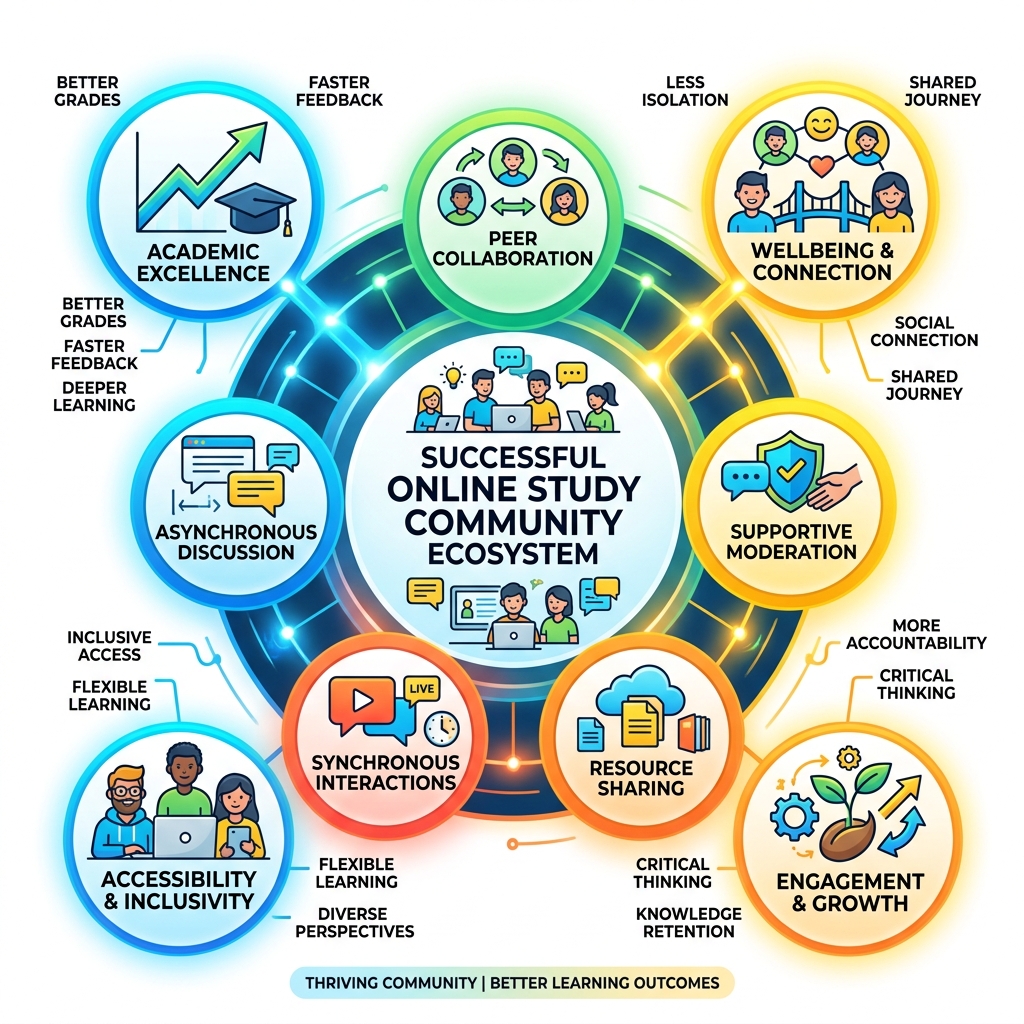
Here’s a quick summary:
- Better grades – Research shows online learning environments have a medium-to-strong effect on academic achievement
- Less isolation – Communities replace the social connection missing from solo online study
- More accountability – Peers keep you on track when self-discipline wavers
- Faster feedback – Get answers and peer review without waiting for office hours
- Deeper learning – Discussing ideas with others builds critical thinking and knowledge retention
- Inclusive access – Online spaces level the playing field for diverse learners
Online learning can feel lonely. You log in, watch a lecture, submit an assignment – and that’s it. No hallway conversations, no study groups forming after class, no one to ask when you’re stuck at midnight.
That’s exactly the gap online study communities fill.
And the data backs this up. A meta-analysis of 27 studies found that online education has a medium-level effect on academic achievement (effect size of 0.409). When blended with strong community elements, that effect jumps even higher – blended learning approaches reached an effect size of 0.586. These aren’t small differences. They translate to real grade improvements.
But the benefits go beyond grades. As one doctoral student put it in published research, “knowledge isn’t built in isolation – it’s co-constructed through dialogue, support, and shared goals.” That insight applies just as much to a sophomore cramming for finals as it does to a PhD candidate.
Whether you’re brand new to online learning or already a few semesters in, understanding how these communities work – and how to use them strategically – can transform your entire academic experience.
Defining the Modern Online Study Community

When we talk about an online study community, we aren’t just talking about a group chat where everyone complains about the midterm. A true community is a digital hub where learners unite over a common goal: mastering their subject matter. These spaces operate through a mix of asynchronous communication (like forum posts and emails) and synchronous meetings (like real-time video calls or live chats).
In these environments, peer-to-peer interaction is the engine that drives success. Instead of just absorbing information from a textbook, we are engaging in “knowledge co-construction.” This is a fancy way of saying we learn better when we explain things to each other, debate different interpretations, and solve problems as a team.
According to 5 Benefits Of An Online Learning Community – SACAP, these communities provide a safe space to engage without the self-consciousness often felt in a crowded physical classroom. This freedom leads to deeper engagement with the course material, as we aren’t just “taking” a class; we are participating in a living, breathing educational network.
The Role of Facilitators and Mentors
In a traditional classroom, the teacher is often the “sage on the stage.” In an online study community, the dynamic shifts. Facilitators and mentors often take on a more informal, guiding role. They act as mentors who foster scholarly conduct and model “netiquette”—the rules of respectful digital behavior.
These mentors help bridge the “transactional distance”—the psychological and communication gap that can happen when we aren’t in the same room. They encourage us to maintain high standards while providing the emotional support needed to keep going. To make the most of this, we recommend Setting Up AI Tools for Academic Productivity to help organize the feedback and resources these mentors provide. When we use technology to streamline the administrative side of learning, we can focus more on the meaningful relationships that these facilitators help build.
Core Benefits of Online Study Communities for Academic Success
The synergy created in an online group often outperforms solo study sessions. When we work together, we aren’t just adding our knowledge together; we are multiplying it. This is rooted in constructivist pedagogy, which suggests that we build our understanding of the world through social interaction and experience.
| Feature | Traditional Classroom | Online Study Community |
|---|---|---|
| Interaction Timing | Scheduled / Limited | 24/7 / Asynchronous |
| Feedback Loop | Weekly / Bi-weekly | Real-time / Immediate |
| Diversity of Peers | Local / Regional | Global / Diverse |
| Knowledge Synthesis | Instructor-led | Peer-driven & Collaborative |
| Information Retention | Standard (Lectures) | Up to 60% higher (Active engagement) |
The research is clear: students can retain up to 60% more information when learning is facilitated through interactive online methods compared to traditional lecturing. This is because we are forced to synthesize information—breaking it down and putting it back together—to explain it to a peer.
As explored in Academic Communities of Engagement: exploring the impact of online and in-person support communities on the academic engagement of online learners, these communities significantly boost both affective (emotional) and cognitive (thinking) engagement. When we feel connected to our peers, we think more deeply about the work.
Enhancing Interaction and Timely Feedback in Online Study Communities for Academic Success
One of the biggest frustrations in college is waiting two weeks for a professor to grade a paper, only to realize you misunderstood a core concept. In an online community, feedback is often immediate. Whether it’s a quick “yes, that’s the right formula” in a chat or a detailed peer review on a draft, the feedback loop is shortened.
Collaborative group work and resource sharing become second nature. We can share links, annotated PDFs, and even shared digital notebooks. To keep this process efficient, we find that Online Classes Made Easier with AI Note-Taking is a lifesaver. AI can help summarize group discussions, ensuring that no “lightbulb moment” is lost in a long thread of messages.
Boosting Motivation and Self-Discipline
Let’s be honest: it’s hard to stay motivated when you’re studying alone in your room at 10 PM. Online communities provide the accountability we all need. Knowing that your study group expects you to show up for a Zoom session or contribute to a shared document creates a healthy level of social pressure.
These communities foster student-centered discussions where we can tailor our engagement to our specific interests. We aren’t just following a syllabus; we are exploring the subject with people who care about it. Using engagement tools like quizzes or virtual “labs” can also turn studying into a more interactive, game-like experience. For more on this, check out our Productivity Tips for College Students with AI to see how you can use technology to set and hit your academic goals.
Fostering Inclusivity and Mental Well-being
One of the most beautiful benefits of online study communities for academic success is how they create a level playing field. In a physical classroom, biases related to appearance, age, or even how loudly someone speaks can affect how they are perceived. Online, the focus shifts to the quality of your ideas.
Anonymity—or at least the digital buffer—can be a huge advantage for shy or socially anxious students. Research from the APA shows that remote learning environments can even lead to a reduction in bullying, particularly for students with neurodevelopmental disorders or those from minority backgrounds. The unsupervised areas of a physical campus where bullying often occurs simply don’t exist in a well-moderated digital community.
Furthermore, 7 Hidden Benefits of Joining an Online Learning Community | EDHEC Online points out that the time and distance provided by asynchronous communication allow us to give more “considered” responses. We have the space to think, research, and craft a thoughtful answer rather than being put on the spot in front of 100 people.
Mitigating Isolation through Online Study Communities for Academic Success
Isolation is the “silent killer” of academic success. It leads to burnout, lack of motivation, and eventually, students dropping out. Online study communities provide the social presence and sense of belonging that we all crave. We aren’t just a name on a roster; we are part of a cohort.
This emotional support is a prerequisite for learning. If you are stressed and lonely, your brain isn’t in a state to absorb complex chemistry or history. By building these digital bridges, we prioritize our mental health. We’ve shared many Productivity Tips for Online Learning that emphasize the importance of balance—connecting with others is just as important as reading the textbook.
Practical Strategies to Maximize Your Community Engagement
So, how do you move from being a “lurker” to an active, successful community member? It starts with time management and a proactive attitude. Don’t wait for someone else to start the discussion—be the one to pose a question or share an interesting resource you found.
- Be Proactive: Introduce yourself early. Share your goals and what you hope to get out of the group.
- Active Participation: Don’t just read; contribute. Even a “Great point, I also thought…” helps build the community fabric.
- Embrace Diverse Perspectives: One of the best parts of online communities is networking with people from different cultures and backgrounds. This diversity enriches our learning and prepares us for a global workforce.
- Use Collaborative Tools: Don’t rely on just one platform. Use video for connection and text for documentation.
For a step-by-step guide on setting these up, see our Tutorial for Effective Group Study Sessions with AI Apps.
Leveraging AI in Online Study Communities for Academic Success
At Vida em Jardim, we believe AI is the ultimate teammate. In an online study community, AI can handle the heavy lifting of organization.
- AI Note-Taking: Use AI to transcribe and summarize your group’s Zoom meetings. This allows everyone to stay present in the conversation rather than frantically typing.
- Collaborative Efficiency: AI tools can help schedule meetings across different time zones, ensuring everyone can participate.
- Data Analysis: If you’re in a STEM field, AI can help analyze data sets or check code, which you can then discuss with your group.
By following our AI Tips for Collaborative Study Efficiency, you can turn your study group into a high-performance academic machine.
Frequently Asked Questions about Digital Learning Groups
How do online study communities directly improve my grades?
The impact is measurable! Meta-analysis data shows that online learning has a medium-level effect size of 0.409 on academic achievement. When you add community elements (like in blended learning), the effect size jumps to 0.586. This happens because communities increase information retention, provide faster feedback, and keep you motivated. For more hacks on boosting your performance, check out how to Ace Online Studies with AI Hacks.
Are online communities as effective as in-person study groups?
They are different, but often complementary. While in-person groups offer high “affective” engagement (the “warmth” of being together), online communities often provide better “cognitive” engagement because they allow for asynchronous reflection and access to a broader range of resources. They aren’t “worse”—they just offer a different modality of support. Learn more in our Collaborative Study Sessions with AI: A Tutorial.
What are the best practices for joining a new online community?
Be proactive and set clear expectations. Look for groups that have a clear structure or “learning agreement.” Don’t be afraid to share facilitation responsibilities—taking turns leading a discussion is a great way to master the material. Finally, make sure you’re In Charge of Your Learning with AI Note-Taking Tips for Online Classes to keep your contributions organized.
Conclusion
The journey through higher education doesn’t have to be a solo trek. By embracing the benefits of online study communities for academic success, we can turn a potentially isolating experience into a vibrant, supportive, and highly effective way to learn.
At Vida em Jardim, we are dedicated to helping you navigate this digital landscape with AI-powered strategies tailored for your academic and personal challenges. Whether you’re looking to boost your GPA or just keep your sanity during a tough semester, the right community—and the right tools—make all the difference.
Ready to take your study game to the next level? Explore our latest Study Hacks and start building your digital support network today!
