
Stop Generic Learning with These Personalized AI Study Aids
Why Generic Study Tools Are Failing Students (And What to Use Instead)
Personalized AI study aids are purpose-built tools that learn your materials, adapt to your pace, and generate study content directly from your notes, lectures, and textbooks — unlike general chatbots that pull from the entire internet and often miss what your professor actually taught.
Here are the top personalized AI study aids worth knowing about:
| Tool | Best For | Key Feature |
|---|---|---|
| StudyFetch | All-in-one studying | Personalized study plans + cram mode |
| Mindgrasp | Diverse content types | Processes PDFs, audio, video, web links |
| MIA | Curriculum accuracy | Trained only on your course materials |
| Penseum | Visual learners | Live screen-reading AI tutor |
| StudySim | Exam simulation | AI-scored open-ended questions |
| StudyBit AI | Mobile studying | Spaced repetition + Feynman practice |
| StudyMonkey | Concept understanding | Adaptive explanations by level |
| SchoolAI | K-12 classrooms | Teacher-monitored AI with safety controls |
If you’re a college student juggling classes, work, and a social life, generic AI tools like ChatGPT can feel like asking a stranger for directions to your professor’s exam — they might get you close, but they don’t know your course, your textbook, or your gaps.
The difference is significant. Tools trained on your specific materials deliver 95% more accurate answers and help students understand concepts 3x faster compared to general large language models. One internal study of 1,000 students found that 92% improved their grades after regularly using a personalized AI study platform, with an average improvement of one full letter grade.
This guide breaks down the best personalized AI study aids available right now — what they do, who they’re for, and how to use them without sacrificing the critical thinking skills you’re in school to build.

Why Personalized AI Study Aids Outperform General Chatbots
When we talk about personalized ai study aids, we aren’t just talking about a chatbot that can write a poem about photosynthesis. We are talking about specialized ecosystems designed to eliminate the “noise” of the internet.
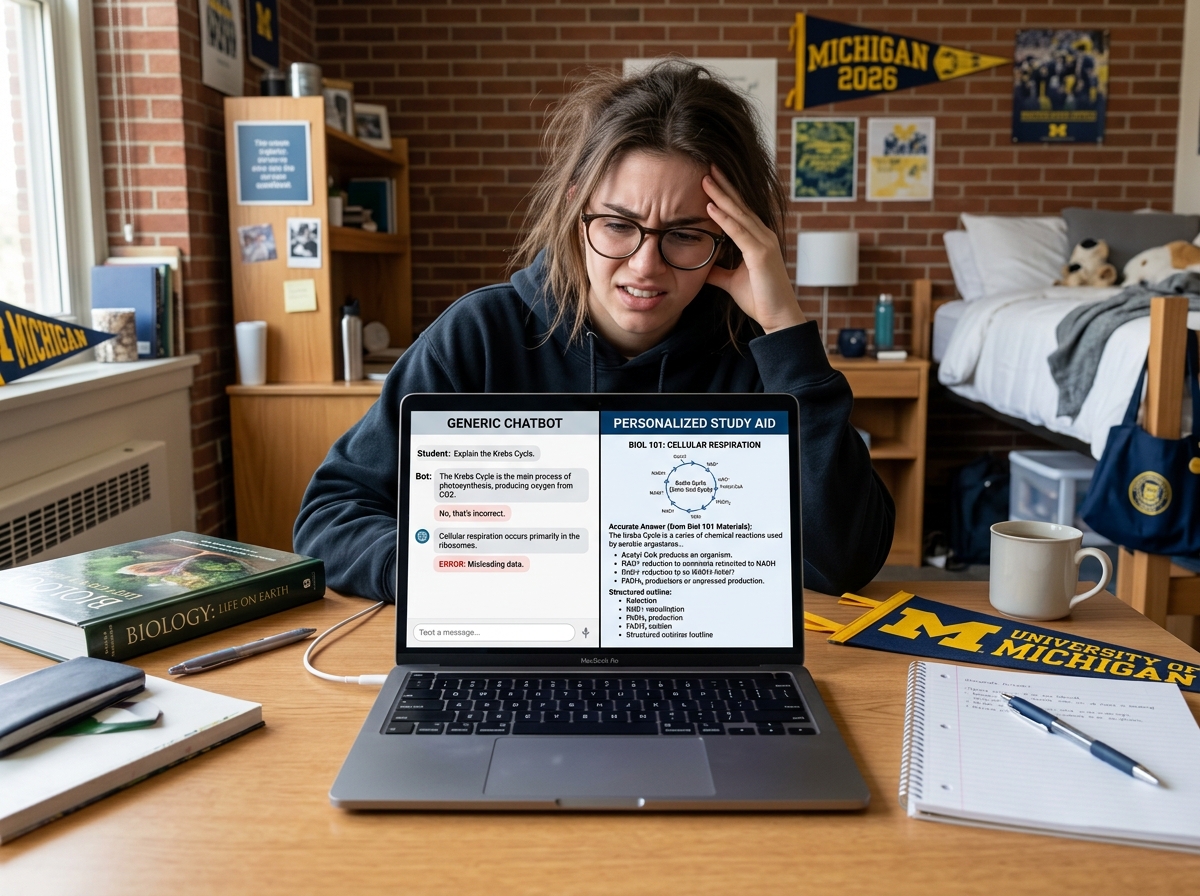
The primary weakness of general AI like ChatGPT is “hallucination”—the tendency to make up plausible-sounding but factually incorrect information. Because general models pull from the entire web, they might use a definition from a 2010 blog post rather than the specific 2024 textbook your professor assigned.
In contrast, platforms like MIA – Study Buddy AI or StudySim operate on a “closed-loop” system. They are trained exclusively on your uploaded materials. If the information isn’t in your PDF or lecture recording, the AI will tell you it doesn’t know, rather than guessing. This leads to 95% more accurate answers and a 3x faster understanding of the material because you aren’t wasting time fact-checking the AI.
For those just starting out, check out our beginners tutorial to AI study apps to see how these specialized tools differ from the basic apps you might already have on your phone.
Maximizing Academic Outcomes with Personalized AI Study Aids
We all want to study less and learn more. It sounds like a late-night infomercial, but the data supports it. Regular users of personalized study platforms report a 30% reduction in study time. Why? Because the AI does the “grunt work” of organizing notes and creating practice tests, allowing you to focus on actual active recall.
The impact on grades is even more impressive. Statistics show a 92% success rate for regular active users, with many students reporting an average improvement of one full letter grade. By targeting your specific weaknesses, these tools ensure you aren’t spending three hours reviewing concepts you already know. If you’re looking to optimize your schedule, we’ve compiled some great tips for improving learning efficiency using AI that pair perfectly with these platforms.
Supporting Diverse Learning Styles with Personalized AI Study Aids
Not everyone learns by staring at a wall of text. One of the biggest perks of personalized ai study aids is their ability to “shape-shift” your data:
- Visual Learners: Tools like Penseum can “see” your screen, drawing diagrams and annotating equations in real-time.
- Auditory Learners: Platforms like StudyFetch can generate 6-to-45-minute podcasts or audio recaps of your lectures.
- Kinesthetic Learners: AI-generated “study games” and interactive quizzes turn passive reading into active participation.
Whether you need a step-by-step video explanation or a scannable summary, these tools adapt to you, not the other way around.
How AI Tailors the Learning Experience to Your Materials
The “magic” happens when you feed the AI your specific course content. Gone are the days of manually typing out flashcards for hours. Modern platforms can process an incredible range of formats:
| Material Type | How the AI Uses It | Resulting Study Aid |
|---|---|---|
| PDFs/PowerPoints | Analyzes text and hierarchy | Structured notes & summaries |
| YouTube/Vimeo Links | Transcribes and timestamps | Searchable video transcripts |
| MP3/MP4 Audio | Records live or uploaded lectures | Auto-generated study guides |
| Images/Diagrams | Vision-based AI analysis | Labeled diagrams & practice questions |
For example, StudyMonkey allows you to upload a complex assignment and get a tailored explanation that matches your current academic level—whether you’re in high school or pursuing a Master’s degree. If you’re struggling with messy handwriting or disorganized files, our guide on leveraging AI tools for structured lecture notes can help you prep your materials for the best AI results.
Cognitive Science Principles in Modern Study Tools
We don’t just want you to pass the test; we want you to remember the material six months from now. Leading personalized ai study aids are built on proven cognitive science principles:
- Active Recall: Instead of rereading a chapter three times (which is largely ineffective), AI tools force you to retrieve information through quizzes and flashcards.
- Spaced Repetition: Platforms like StudyBit AI track when you’re likely to forget a concept and resurface it just in time, improving retention by up to 85%.
- The Feynman Technique: AI tutors often ask you to explain a concept back to them, identifying gaps in your logic.
- SQ3R Framework: AI can guide you through the Survey, Question, Read, Recite, and Review process automatically.
If you want to dive deeper into the “how-to,” check out our tutorial for creating AI flashcards to see these principles in action.
Ethical Use and Avoiding the GPS Effect in Academics
While we love these tools, we have to talk about the “GPS Effect.” Just as relying solely on a GPS can weaken your internal sense of direction, relying too much on AI can soften your critical thinking skills.
Best practices for responsible use:
- Verify, Don’t Just Trust: Use the AI’s citations to cross-reference with your actual textbook.
- The “Starting Point” Rule: Use AI to generate an outline or a summary, but do the heavy lifting of writing and synthesizing yourself.
- Academic Integrity: If a tool writes your entire essay, it’s not your work. Use AI as a tutor, not a ghostwriter.
As we discuss in our strategies for streamlined homework management, the goal of AI is to remove administrative friction, not to do the thinking for you.
Data Privacy and Security in AI Learning Platforms
When you’re uploading your personal notes and school documents, privacy is a non-negotiable. Leading platforms now take a “privacy-first” approach. This means:
- Non-Training Agreements: Your data is not used to train future versions of the AI model.
- Encryption: Your materials are private by default and encrypted during transit and at rest.
- Student Safety: Platforms like SchoolAI even include real-time monitoring for teachers to ensure a safe learning environment.
When setting up AI tools for academic productivity, always check the settings to ensure your “History” or “Data Training” options are configured to your comfort level.
Frequently Asked Questions about Personalized AI Study Aids
How do these tools differ from ChatGPT?
While ChatGPT is a general-purpose tool, personalized ai study aids are “curriculum-aware.” They provide verified citations back to your specific textbook, offer specialized study modes (like “Cram Mode”), and are significantly less likely to hallucinate because they are grounded in your provided documents.
What types of files can I upload for personalization?
Most premium tools accept a massive variety of inputs, including:
- PDF and Word documents
- PowerPoint slides
- MP3 and WAV audio files (for lectures)
- YouTube and Vimeo links
- Photos of handwritten notes
Can AI study aids help with standardized test prep?
Absolutely. Students are currently using these tools to prepare for high-stakes exams like the MCAT, LSAT, NCLEX, and SAT. By uploading past practice exams and prep books, the AI can create a custom study calendar that identifies exactly which sections (like Organic Chemistry or Logical Reasoning) need the most work.
Conclusion
The era of “one-size-fits-all” education is over. By leveraging personalized ai study aids, we can finally move away from generic, inefficient learning and toward a system that actually respects our time and unique learning styles. Whether you’re trying to save 10+ hours a week or simply want to walk into your next exam with total confidence, these tools are the bridge to getting there.
At Vida em Jardim, we believe that when students have the right technology in their corner, there’s no limit to what they can achieve. Ready to level up your academic game? Unlock your full potential with our latest study hacks and start learning smarter, not harder.
