
Why Student Podcast Learning AI Is Reshaping How You Study
Student podcast learning AI is one of the fastest-growing tools for college students who want to study smarter, not harder. Here are the top podcasts and AI tools worth knowing about:
- AI in Education Podcast – Weekly deep dives on how AI is changing study habits and learning
- AI and I – First-person student perspectives on learning in AI-powered schools
- Leading & Learning with AI – Real stories from education leaders on AI strategy and student outcomes
- CS-Ed Podcast – Research-backed discussions on how AI affects student help-seeking and social learning
- Higher Ed Spotlight – Expert takes on AI tools like Khanmigo and their impact on student engagement
Between packed class schedules, part-time jobs, and a social life that refuses to pause, finding time to actually absorb course material is tough.
That’s where AI-powered podcasts come in. Instead of staring at dense textbooks, students are now listening to their notes and readings as engaging audio conversations – during commutes, workouts, or while cooking dinner.
The results are hard to ignore. One study with 180 college students found that those who listened to personalized AI-generated podcasts scored higher on comprehension tests than those who relied solely on textbooks. Students also reported finding the audio format more enjoyable.
Tools like Google NotebookLM – which launched its audio feature in September 2024 – can turn your class notes, PDFs, or lecture slides into a natural-sounding podcast in minutes. And a growing number of education podcasts are exploring exactly how students like you are using these tools to stay motivated and get ahead.
But it’s not all straightforward. Questions around accuracy, social connection, and over-reliance on AI are real and worth understanding before you dive in.
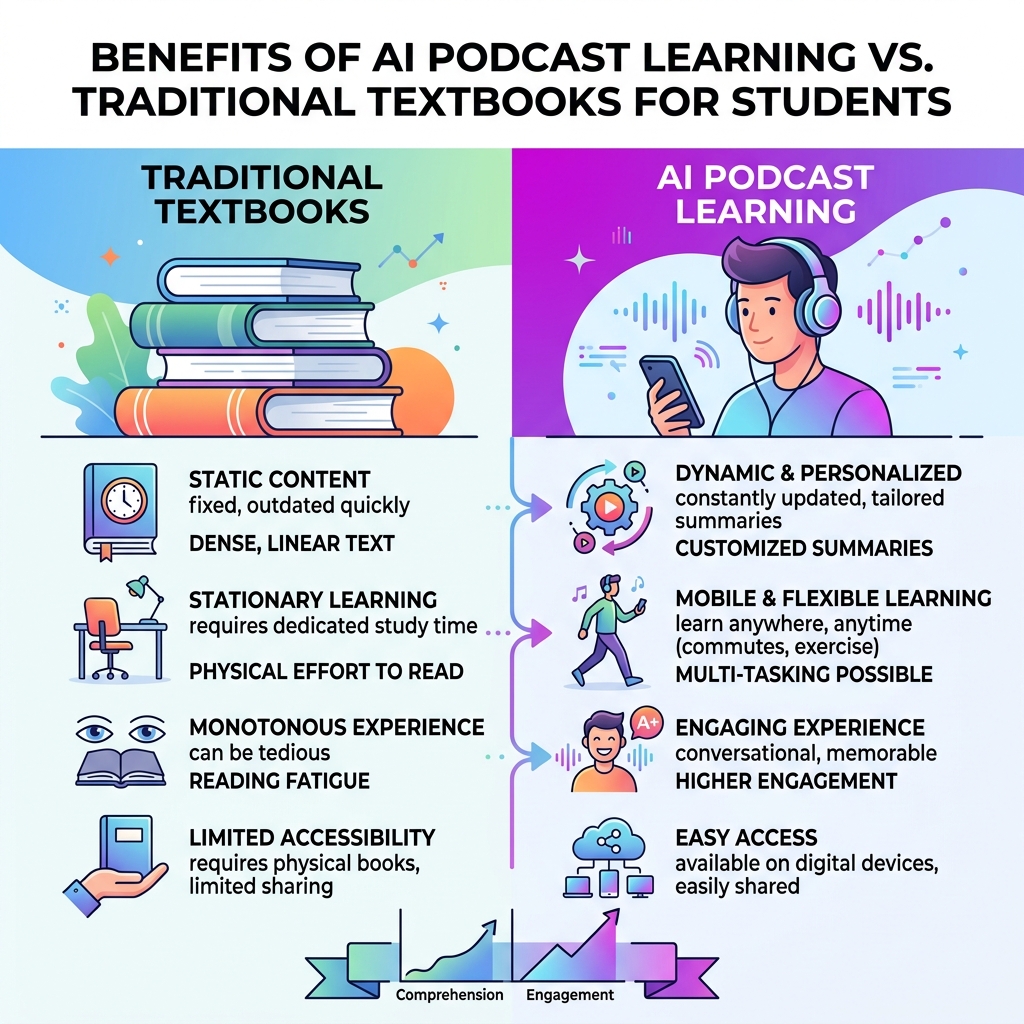
How a Student Podcast Learning AI is Changing Study Habits
We are witnessing a fundamental shift in how information moves from a page into a student’s brain. For decades, the gold standard was the highlighter and the library cubicle. But today, student podcast learning AI is turning that lonely slog into a dynamic, conversational experience.
When we look at the data, the impact is striking. A study involving 180 college students revealed that those using personalized AI-generated podcasts didn’t just enjoy the process more—they actually performed better. These students scored higher on comprehension tests compared to their peers who stuck to traditional textbooks. Why? Because audio learning, especially when it’s conversational, creates “emotional resonance.” It’s much easier to remember a concept when two AI “hosts” are debating it with enthusiasm than when it’s buried in a 500-page PDF.
Tools like Google NotebookLM are the engines behind this change. By feeding your class notes or textbook chapters into the system, you can generate a 5-to-20-minute “Audio Overview.” This isn’t just a robot reading text; it’s a discussion that highlights key themes, asks probing questions, and even adds human-like pauses.
As discussed in the AI in Education Podcast: Students First: How AI Is Changing Study Habits, students aren’t using these tools because they are “lazy.” Instead, they are using them to fill gaps in clarity and support that traditional classrooms sometimes leave behind. For many of us, listening to a podcast while walking to campus is the ultimate productivity tip for online learning, allowing us to “double time” our professional and academic development.

Top Podcasts for AI-Driven Learning and Motivation
If you want to stay ahead of the curve, you need to know which voices are leading the conversation. We’ve been following several experts who believe that AI isn’t just a “cheat code”—it’s an equalizer.
Sal Khan, the founder of Khan Academy, has been vocal about AI’s potential to provide customized, engaging lessons for every student through platforms like Khanmigo. Meanwhile, Wharton professor Ethan Mollick argues that we need fewer policy debates and more actual “demos” of how AI can work in the classroom. He views AI as a “co-intelligence” that can spark thought rather than just providing answers.
However, it’s not all sunshine and rainbows. On the S4xE14: GenAI’s Impact on Student Help Seeking and More – CS-Ed Podcast Home Page, researchers like Irene and Kristin discuss the “grim” side of the AI revolution. They’ve found that while AI is incredibly convenient, it can lead to social isolation. If you can ask ChatGPT a question at 2 AM, you’re less likely to go to office hours or join a study group. This shift can erode the “social fabric” of university life, which is where we often develop our most important soft skills.
“AI and I” and the Student Podcast Learning AI Experience
One of the most fascinating glimpses into the future comes from the “AI and I” podcast, specifically the episode featuring Alex Mathew. Alex is a student at Alpha School, a K-12 network that uses AI for all academic content. In this “teacherless” model, students spend their mornings in 2-to-3-hour AI-driven learning blocks.
There are no traditional teachers delivering lectures. Instead, there are “guides” whose only job is to provide emotional support and motivation. Alex describes a world where he negotiates his schedule based on “mastery.” If he masters a concept quickly using AI, he earns time to work on his own world-class projects—like building an AI-powered stuffed animal for teen mental health.
This highlights a key trend in student podcast learning AI: Gen Z is “rationally optimistic.” While they see the uncertainty in the job market, they are using AI to build websites, found clubs, and prepare for debates. They are moving away from being passive consumers of information and becoming active creators. You can hear his full story here: Meet the Student With No Teachers, No Homework—Just AI – AI and I – Podcast Episode – Podscan.fm.
Leading & Learning with AI
For those interested in how schools are managing this transition, the Leading & Learning with AI podcast by Panorama Education is essential. It focuses on the strategic side—how leaders can build AI literacy without sacrificing safety or human connection.
The podcast emphasizes that AI should be student-specific, not just curriculum-aligned. We’ve found that when students feel “in charge” of their learning, their motivation skyrockets. This is why we often recommend that you be in charge of your learning with AI note-taking tips for online classes. By taking control of how you organize and process information, you move from being a student to being a self-directed learner.
The AI in Education Podcast
Hosts Dan Bowen and Ray Fleming have been exploring this “skunkworks” world of AI since 2019. One of their most important contributions is the concept of “metacognitive laziness.” This is the risk that students might offload all their thinking to generative tools, essentially letting the AI do the heavy lifting while their own critical thinking muscles atrophy.
They argue that AI should be an “efficiency engine,” not a “cognitive crutch.” For example, using AI to summarize a long research paper is efficient; using it to write your entire thesis without understanding the core arguments is a crutch. We’ve seen how online classes made easier with AI note-taking can help you stay organized, but only if you remain the “human in the loop” who validates the final output.
From Textbooks to Audio: The Rise of AI-Generated Podcasts
The transition from text-heavy learning to audio-based student podcast learning AI is happening faster than many expected. Let’s look at how these two methods stack up:
| Feature | Traditional Textbook | AI-Generated Podcast (e.g., NotebookLM) |
|---|---|---|
| Engagement | Often low; can feel dry and clinical | High; conversational and emotionally resonant |
| Time to Process | Hours of focused reading | 5-20 minutes of active listening |
| Accessibility | Difficult for dyslexic or visually impaired learners | Highly accessible; supports diverse learning styles |
| Customization | One-size-fits-all | Personalized to your specific notes and gaps |
| Comprehension | Varies; requires high mental effort | Proven to improve concept retention in studies |
Google’s NotebookLM is a game-changer here. It allows you to upload up to 50 sources—including PDFs, Google Docs, and even YouTube URLs—and converts them into a discussion. Each source can be up to 500,000 words, meaning you could theoretically feed it your entire semester’s worth of reading.
Another tool, PodSumm, can create audio summaries of research text in under a minute. This is a massive time-saver for students who need to stay on top of the latest clinical studies or academic papers. As we saw in the case of Colaberry interns, students are even building their own AI systems to automate complex tasks like grading. You can read about their journey here: From Manual to Machine: Building a Production-Ready AI Grading System.
This rise in audio learning is particularly beneficial for neurodivergent learners. For a student with dyslexia, a 20-minute AI podcast that summarizes a chapter is a lifeline that levels the playing field.
Navigating the Social and Ethical Impact of AI in Education
While we love the productivity gains, we have to talk about the “culture shock.” Some students returning to university after a break have reported feeling isolated by the pervasive use of ChatGPT. Instead of asking a friend for help with a coding bug—which might lead to a 20-minute conversation about their weekend—they ask the AI.
This reduces “weak ties”—those casual acquaintances that often lead to job referrals or new perspectives. If we only interact with AI, we miss out on the unique passions and inspirations that only our peers can provide. That’s why we encourage you to ace online studies with AI hacks while still making time for “homework parties” or in-person study sessions.
Addressing Bias and Accuracy in Student Podcast Learning AI
One of the biggest hurdles is the “hallucination” problem. AI is a world-class bullshitter; it can sound incredibly confident while being completely wrong.
When using student podcast learning AI, we recommend these best practices:
- Fact-Check Technical Terms: AI hosts can occasionally mispronounce or misinterpret complex jargon.
- Vet the Sources: Ensure the documents you upload to tools like NotebookLM are high-quality and factual.
- Transparency: If you’re using AI to help create a presentation or summary, be open about it.
- Human-in-the-Loop: Always review the AI-generated podcast against your original notes to ensure no critical nuances were lost.
The Future of Student Podcast Learning AI and Social Learning
The future isn’t about AI replacing teachers or peers; it’s about AI facilitating better human connections. Imagine an AI that identifies two students struggling with the same concept and suggests they meet up to discuss it.
We believe that as AI takes over the “content delivery” (the lectures and summaries), the value of “connection” will only increase. Universities will shift from being places where you get information to places where you apply information through collaboration and soft skills.
Despite the career uncertainty that AI brings, many students remain “rationally optimistic.” They see AI as a tool that can help them build “Olympic-level” projects earlier in their lives. The key is to maintain your curiosity and not let the AI do your thinking for you.
Frequently Asked Questions about AI Podcasts in Education
What are AI-generated podcasts and how are they created?
AI-generated podcasts are audio discussions created by artificial intelligence based on text inputs. Tools like Google NotebookLM use “Audio Overviews” to transform documents, PDFs, and notes into a conversational format featuring two AI hosts. They analyze the key themes and present them as a natural-sounding dialogue, complete with interruptions and “human” inflections.
Are AI podcasts more effective than traditional textbooks for studying?
Research suggests they can be! In a study of 180 college students, those using personalized AI podcasts scored higher on comprehension tests. The conversational nature of podcasts provides “emotional resonance,” making complex topics more engaging and easier to remember than dry textbook prose. However, they are best used as a complement to traditional reading, not a total replacement.
How can students use tools like NotebookLM to improve their grades?
Students can use NotebookLM to:
- Summarize dense textbook chapters into 15-minute primers before class.
- Identify gaps in their own lecture notes.
- Create study guides from multiple sources (up to 50 files).
- Listen to course material while commuting, which increases total study time without causing burnout.
Conclusion
At Vida em Jardim, we believe that student podcast learning AI is a powerful ally in your academic journey. By turning the “manual labor” of reading into the “engaging experience” of listening, you can reclaim your time and boost your motivation.
Whether you’re listening to the AI in Education podcast to understand the latest research or using NotebookLM to prep for your next exam, the goal remains the same: use AI to enhance your human potential, not replace it. Stay curious, stay connected, and keep looking for those more info about AI study hacks that give you the edge.
The world of education is changing fast, but with the right tools and a bit of rational optimism, you’re more than ready to lead the way.
