Spring Door Basket: A Hanging Alternative to a Wreath
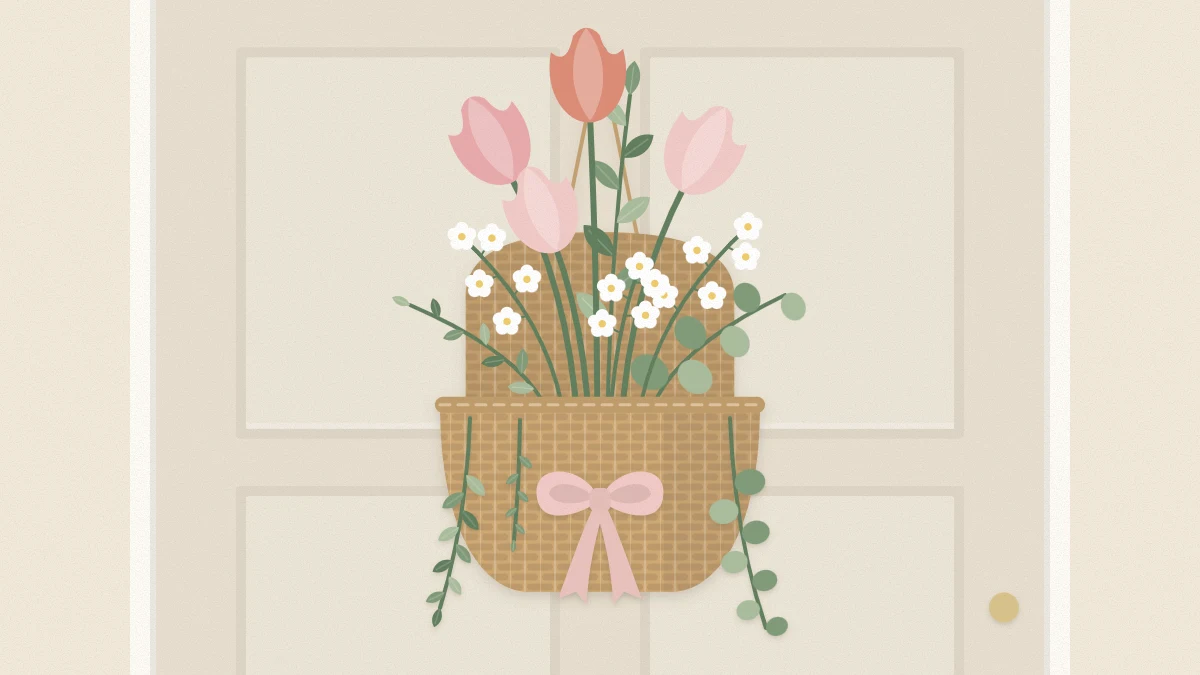
Fill a flat-backed hanging basket with faux stems for the front door: filler, tall stems at the back, trailing greenery in front, a few eggs on picks, a bow and a hanging loop that holds.
Tutorial at a glance
Materials
- Flat-backed woven basket, 10 to 12 in (25 to 30 cm) wide
- Dry floral foam or crumpled kraft paper
- Faux tall, medium and trailing stems
- 3 to 5 craft eggs on picks
- Wide ribbon for a bow and a hanging loop
- Felt pads for the back
A spring door basket does the same job as a wreath with a completely different shape. It hangs flat against the door like a pocket, and the flowers rise out of the top and spill over the front as though just gathered from a garden.
It is also one of the easier door decorations to build. There is no base to cover and no wiring around a ring: the stems simply stand in a block of filler, and you can keep adjusting them until the arrangement looks right.
Choose a Flat-Backed Basket
The basket needs one flat side so it sits snugly against the door and does not swing or tilt. Wall baskets, flat-backed flower baskets and woven wall pockets are all made this way. A size of roughly 10 to 12 inches (25 to 30 cm) wide and 8 to 10 inches (20 to 25 cm) tall suits a standard door.
Check three things before you start:
- Depth. A basket 3 to 5 inches (8 to 13 cm) deep holds enough stems without standing far out from the door.
- Handle or rim. A sturdy handle or a firm back rim gives you somewhere to attach the hanging loop.
- The back surface. Run a hand over it and trim any sharp cane ends or wire that could mark the door.
Gather Stems in Three Groups
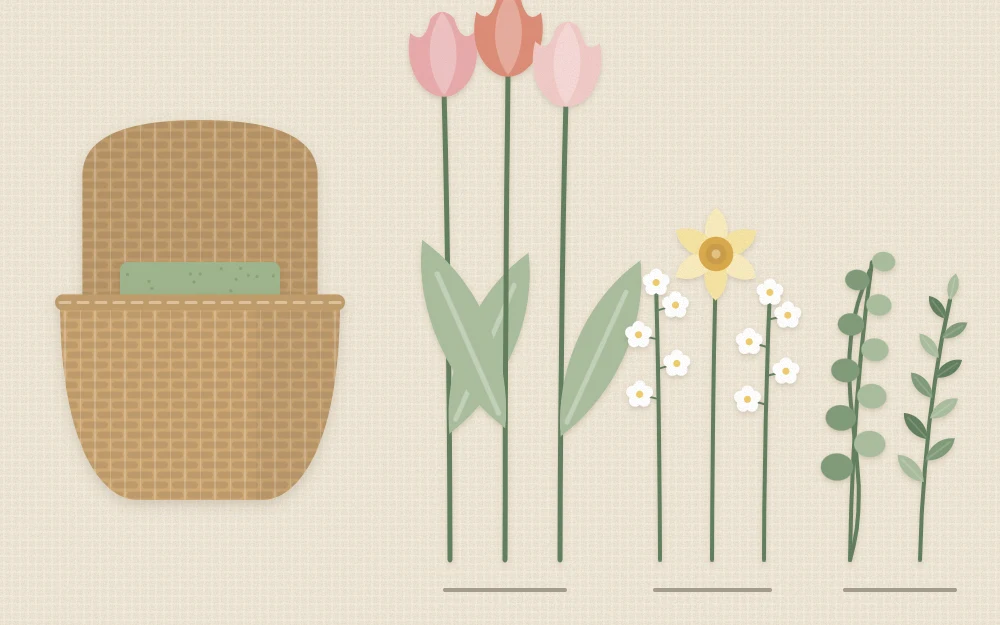
Faux stems are the practical choice for a door, since they need no water and hold their shape for the whole season. Sort them into three groups before arranging:
- Tall: five to seven upright stems such as tulips, daffodils, forsythia sprays or pussy willow.
- Medium: three to five fuller flowers, such as ranunculus, small roses or clusters of white blossom.
- Trailing: two or three pieces of ivy, eucalyptus or fern that will hang over the front edge.
Limit the palette to two flower colors plus green and white. For help choosing blooms that look convincing together, see the guide to spring faux flower arrangements. Handmade blooms are another option on a sheltered door, and the paper spring flowers tutorial shows how to put them on wire stems.
Fill the Basket
The filler holds every stem at the angle you set, so it needs to fit tightly.
- Dry floral foam: the kind sold for faux and dried flowers. Cut a block with a serrated knife to wedge firmly inside the basket, stopping about 1 inch (2.5 cm) below the rim.
- Crumpled paper: kraft paper or packing paper scrunched into tight balls and packed in hard. It is lighter and uses what you already have, though stems shift more easily.
If the foam is loose, pack paper around it or tie it in with a length of floral wire passed through the weave. Cover the top with a thin layer of dried moss or paper shred so no filler shows between the stems.
Arrange from Back to Front
Cut stems with wire cutters as you go, testing each against the basket before trimming. It is easier to shorten a stem than to wish it longer.
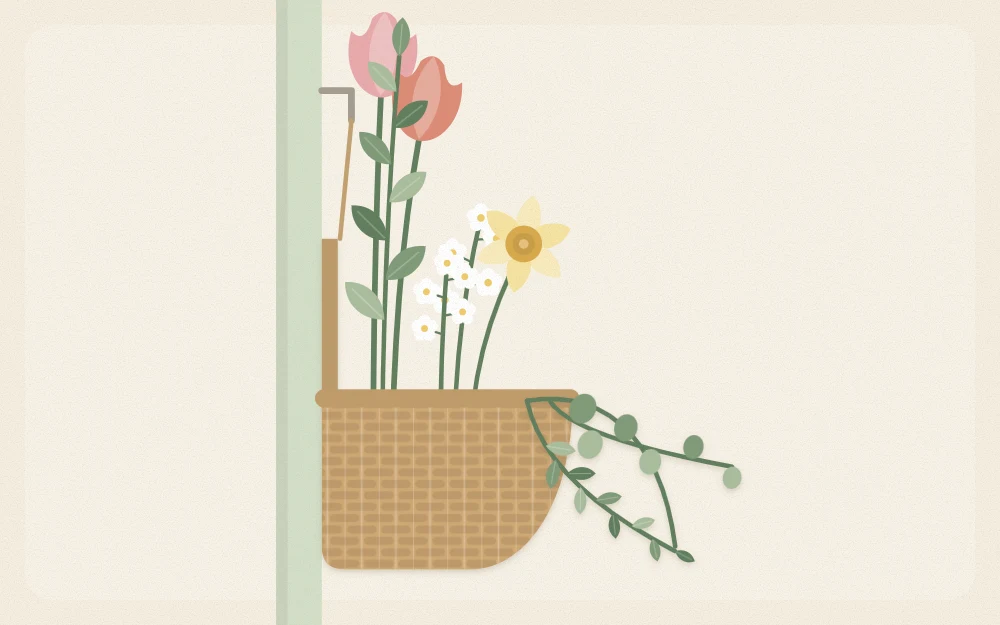
- Tall stems at the back. Push them into the filler along the flat back edge, upright or leaning very slightly backward. The tallest should rise about one and a half times the height of the basket above the rim.
- Fan the sides. Angle the outer tall stems a little to the left and right so the outline is a soft fan rather than a column.
- Medium flowers in the middle. Cut these shorter and set them in front of the tall stems, heads at different heights, tilted slightly forward.
- Trailing greenery at the front. Insert these stems almost horizontally at the front rim so they drape over the edge and soften the basket.
- Fill the gaps. Tuck short leaf pieces or small blossom sprigs into any spot where filler still shows.
Tip
Hang the basket on a hook at eye level while you arrange it. A basket styled lying on a table often looks sparse or lopsided once it is upright.
Add Eggs on Picks and a Bow
Three to five craft eggs are enough to turn a spring basket into an Easter one. To put an egg on a pick, make a small hole in the wide end of a foam or plastic egg, add a drop of tacky glue and push in a wooden skewer or floral pick. Let the glue set, then push the pick into the filler so the egg nestles among the medium flowers.
After the holiday, pull the picks out and the basket carries on through spring.
For the bow, tie a simple two-loop bow from ribbon about 1.5 inches (4 cm) wide and wire it to the front of the basket or the base of the handle. Leave the tails long and trim them at a slant.
Make a Secure Hanging Loop
A filled basket is heavier than most wreaths, so the hanger deserves attention.
- Cut about 20 inches (50 cm) of strong ribbon, jute cord or paddle wire wrapped in ribbon.
- Thread it through the weave at two points on the back rim, a few inches apart, and knot firmly. Two anchor points keep the basket level.
- Hang it from an over-the-door wreath hanger or a removable adhesive hook rated above the weight of the finished basket, following the instructions for the door surface.
- Give the basket a gentle tug and open and close the door a few times to check that it stays put.
Keep the Door Free of Scratches
The flat back rests directly on the paint, so soften every contact point. Stick small felt furniture pads to the lower corners of the back, or glue a piece of felt over the whole back panel. Tuck all wire ends inside the basket, and slip a strip of felt behind a metal over-the-door hanger where it meets the door edge.
On an exposed door, use weather-tolerant faux stems and skip paper pieces, which soften in rain. If you would still like a ring as well, the classic DIY Easter wreath uses many of the same stems.
Frequently asked questions
What kind of basket works for a front door?
Look for a basket with one flat side, often sold as a wall basket or wall pocket. The flat back lets it rest against the door without tipping forward. A depth of 3 to 5 inches is enough to hold filler and stems while keeping the arrangement close to the door.
How do you keep stems from falling out of a door basket?
Wedge a block of dry floral foam tightly into the basket and push every stem at least 2 inches into it. If the foam moves, pack crumpled paper around it or wire it to the weave. For extra hold on a busy door, dip stem ends in tacky glue before inserting them.
Can fresh flowers be used in a door basket?
They can for a single day or an event, with the stems in water tubes or a sealed jar hidden inside the basket. Fresh flowers add weight and wilt quickly outdoors, so faux stems are the practical choice for a basket meant to hang for several weeks.