Paper Spring Flowers: Tulips and Daffodils from Cardstock
Make two simple cardstock flowers: a cupped tulip from three overlapping petals and a daffodil from a six-petal star with a rolled trumpet. Includes shaping, stems, leaves and arranging a bunch in a jar.
Tutorial at a glance
Materials
- 65 lb (176 gsm) cardstock in flower colors and green
- Floral wire with floral tape, or green paper straws
- Tacky glue
- Pencil for shaping
- Small sharp scissors
Paper spring flowers give you tulips and daffodils that never droop, in exactly the colors your room needs. Both flowers here are cut from ordinary cardstock, shaped over a pencil and glued to a simple stem, and a small bunch in a jar looks fresh for the whole season.
The tulip is a cup of three overlapping petals. The daffodil is a flat six-petal star with a rolled trumpet at its center. Neither needs a pattern more complicated than a petal you can draw freehand.
Paper, stems and tools
Cardstock of about 65 lb (176 gsm) is the right weight: firm enough to hold a curve, light enough to shape without cracking. Heavier sheets tend to crease instead of curling. If you are building up a kit, the Easter craft supplies starter list covers paper weights and cutting tools in more detail.
- Cardstock in pink, coral, yellow, a deeper yellow or orange, and green
- Stems: 18-gauge floral wire wrapped in green floral tape, or green paper straws
- Tacky glue for paper-to-paper joins; a low-temperature glue gun for attaching stems
- A pencil, small sharp scissors and a ruler
Wire stems can be bent into a natural lean. Paper straws are quicker, need no wrapping and stand very straight, which suits a tidy, graphic bunch.
How to shape petals over a pencil
Flat paper looks like flat paper. A few seconds of shaping is what turns a cut-out into a petal.
Lay a petal on your palm and roll the side of a pencil firmly along its length, from base to tip, three or four times. The paper will start to cup. To curl a tip outward, wrap just the top of the petal backward around the pencil and hold it for a moment. Work gently; a hard fold cannot be smoothed out again.
Tip
Paper has a grain, and it curls more smoothly in one direction than the other. Test a scrap strip both ways and cut your petals so their length follows the easier curl.
Make the tulip
Each tulip needs three petals. Draw a teardrop-shaped petal about 2.5 in (6.5 cm) tall and 1.75 in (4.5 cm) wide, with a broad rounded top that comes to a soft point and a base about 0.5 in (1.3 cm) wide. Cut one, check the shape, then use it as a template.
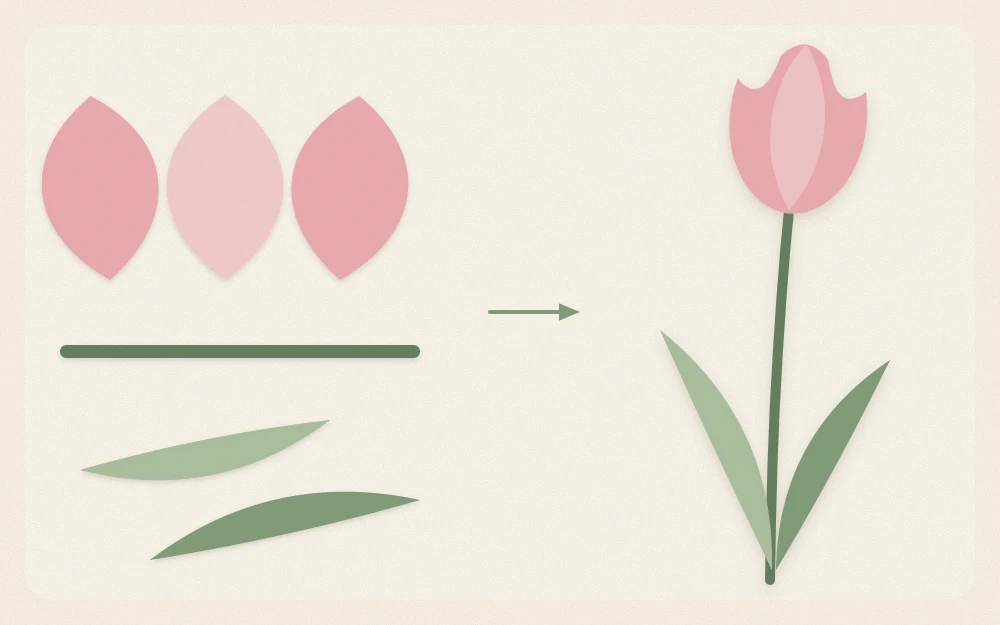
- Cut three petals and cup each one over the pencil so it curves inward along its length.
- Cut a slit about 0.5 in long up the center of each petal’s base. Overlap the two flaps and glue them. This small dart pulls the petal into a deeper cup.
- Glue the base of the first petal to the top of the stem, with the cup facing inward.
- Add the second petal so it overlaps the first by about a third, then the third so it overlaps both. The three bases wrap around the stem like a collar.
- Pinch the base gently while the glue sets, then wrap a narrow strip of green paper or floral tape around the join to hide it.
For a tulip that is just opening, curl the tips of the petals very slightly outward. For a tight bud, overlap the petals by half and leave the tips straight.
Make the daffodil
The daffodil has two parts: a flat star of six petals and a small trumpet. Using a pale yellow for the star and a deeper yellow or orange for the trumpet gives the most recognizable look.
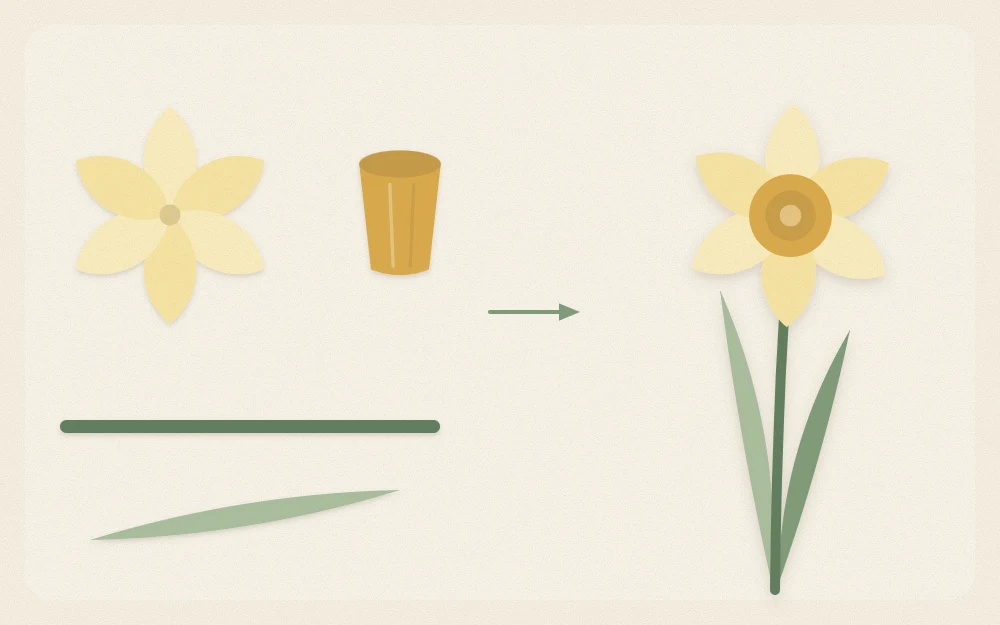
- Draw a circle about 3.5 in (9 cm) across and divide it into six equal wedges. Shape each wedge into a pointed petal, leaving a center about 0.75 in (2 cm) across uncut. Cut out the star.
- Roll the pencil along each petal so it curves slightly backward, away from the front of the flower, and pinch each tip lightly.
- For the trumpet, cut a strip about 3 in long and 1 in wide (7.5 x 2.5 cm). Snip small notches along one long edge for a frilled rim, and cut a row of tabs about 1/4 in (6 mm) deep along the other.
- Roll the strip around the pencil into a tube, overlap the ends and glue. Fold the tabs outward and flare the frilled edge with a fingertip.
- Glue the tabs to the center of the star. Attach the stem to the back of the star and cover the join with a small green paper circle.
Daffodils nod. If you used wire, bend the top 1 in of the stem forward so the flower faces outward rather than straight up.
Add leaves
Leaves make the difference between flowers on sticks and a believable bunch. Cut long, narrow blades from green cardstock, about 5 to 6 in (13 to 15 cm) long and 0.75 in wide for tulips, slightly narrower for daffodils.
Fold each leaf lightly in half along its length to make a center crease, then open it and curve the tip backward over the pencil. Glue the bottom 1 in of the leaf around the lower part of the stem. Two leaves per tulip and one or two per daffodil is plenty.
Arrange a small bunch in a jar
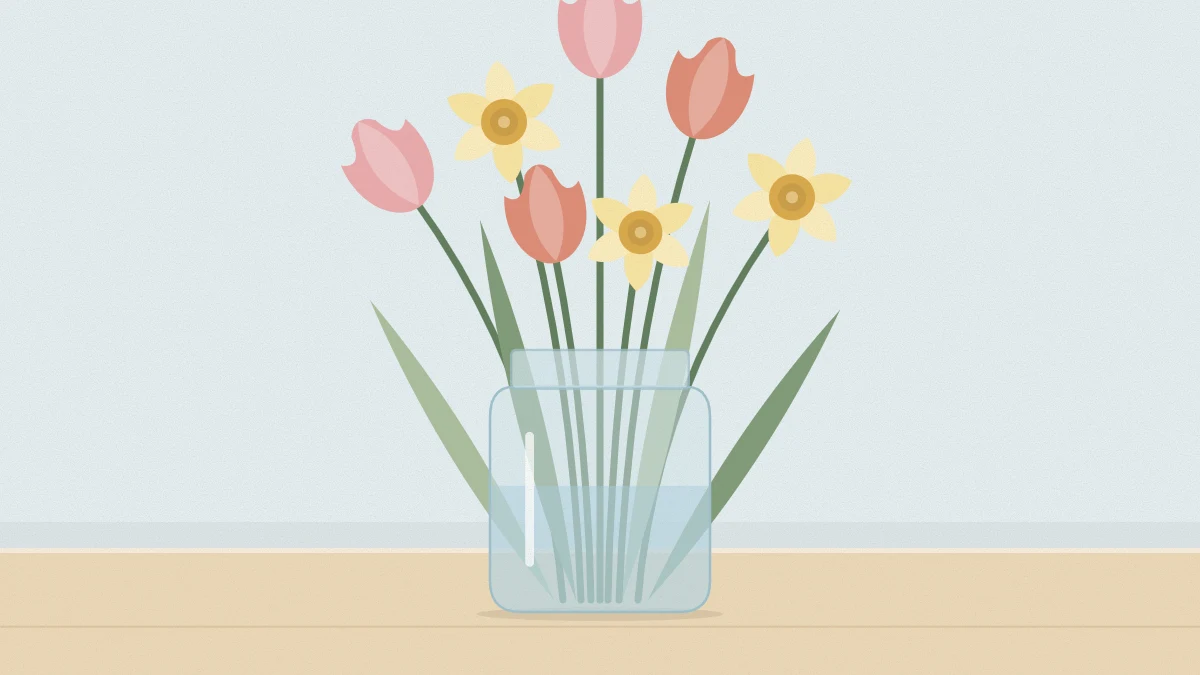
An odd number of flowers looks most natural: five tulips and four daffodils fill a medium jar. Vary the stem lengths by an inch or two so the heads sit at different heights, with the tallest about one and a half times the height of the jar.
A paper bunch is light, so the stems tend to splay. Put a handful of dry pebbles, a ball of crumpled paper or a piece of floral foam in the bottom of the jar to hold them. Do not add water. The principles of spacing and proportion are the same as for faux flower arrangements in jars and pitchers, and paper stems mix well with faux greenery.
Other ways to use the flowers
Without stems, the same flowers work as flat decorations. Glue a tulip to a gift tag, lay daffodils along a table runner, or cover a ring with blossoms as in the paper flower Easter wreath.
Keep paper flowers out of direct sun, which fades cardstock over a few weeks, and away from steam, damp and candle flames. Stored upright in a tall box with tissue between the heads, a bunch will be ready to use again next spring.
Frequently asked questions
What paper weight is best for paper flowers?
Cardstock around 65 lb (176 gsm) is a good middle ground. It curls over a pencil without cracking and holds the shape once glued. Lighter text-weight paper makes delicate petals that flop, while very heavy cardstock tends to crease along the curve instead of bending smoothly.
How do I stop paper flower heads from drooping on the stem?
Make sure the join is supported on all sides. Wrap the petal bases fully around the stem, hold them until the glue grips, and then bind the join with a strip of paper or floral tape. A stem that is too thin for the flower head will also bend, so use sturdier wire or a paper straw.
How long do paper flowers last?
Kept dry and out of direct sunlight, cardstock flowers hold their shape and color for a season and can be reused in later years. Bright sun fades the paper gradually, and humidity relaxes the curls, so a spot away from windows, kitchens and bathrooms is best.