Easter Egg Wreath: How to Attach Craft Eggs to a Wreath Form
Plan and build a full ring of craft eggs on a foam form: how many eggs to buy for a 12 or 14 inch wreath, how to glue an outer row, an inner row and a top layer, and how to fill the gaps with moss.

Tutorial at a glance
Materials
- 12 to 14 in (30 to 36 cm) foam wreath form
- About 50 to 65 plastic or foam craft eggs in three sizes
- Hot glue gun and glue sticks
- Preserved moss or small faux leaves
- Ribbon to wrap the form and to hang it
An easter egg wreath is one of the few door decorations that looks generous from across the street and still rewards a closer look. The whole ring is covered in eggs, packed closely enough that the form underneath disappears, with a little moss or greenery softening the joins.
The method is simple, but the result depends on planning: how many eggs you need, how the sizes are mixed, and the order in which the rows go on. Work that out before the glue gun warms up and the build itself is calm and quick.
Why craft eggs suit a door better than real shells
A door opens, closes and occasionally slams. Blown eggshells are beautiful on a shelf or a branch, but on a wreath they crack at the first knock, and a single broken shell leaves a gap that is awkward to repair. Dozens of real shells also need far more preparation than a wreath is worth.
Lightweight plastic or foam craft eggs solve both problems. They weigh very little, so the finished wreath hangs from a ribbon or a removable adhesive hook without pulling, and they survive being bumped. Plastic eggs with a matte or speckled finish look the most natural. Foam eggs are lighter still and take paint well, though their surface dents if pressed hard.
Avoid solid wooden eggs for a full ring. A few are fine as accents, but fifty of them make a wreath heavy enough to strain both the glue and the hanger.
How many eggs to buy
The count depends on the size of the form and the size of the eggs. For a full ring with an inner row, an outer row and a top layer, these rough numbers are a sensible starting point. Buy a few extra, because the last gaps always need one more small egg than expected.
| Wreath form | Large eggs | Medium eggs | Small eggs |
|---|---|---|---|
| 12 in (30 cm) | About 14 | About 20 | About 18 |
| 14 in (36 cm) | About 18 | About 24 | About 22 |
Here, large means roughly 2.5 in (6 cm) long, medium about 2 in (5 cm) and small about 1.5 in (4 cm). Two sizes work, but three sizes fill the curve of the ring more easily and give the surface a natural, gathered look.
Materials and preparation
- A foam wreath form, 12 to 14 in across, with a flat back if possible
- Craft eggs in two or three sizes and three or four colors
- A hot glue gun and glue sticks; a low-temperature gun is kinder to foam
- Preserved moss or small faux leaves for the gaps
- Wide ribbon for hanging, about 1 yard (0.9 m)
Wrap the form in ribbon or strips of fabric in a color close to the eggs before you begin. It takes a few minutes, hides any foam that shows between eggs, and gives the glue a better surface to grip. If you are unsure which adhesive suits your eggs, the guide to choosing glue for Easter crafts compares the options by material.
Sort the eggs by size into separate bowls, then tie the hanging ribbon around the form now. Once the eggs are on, there is no room to thread it through.
Gluing the eggs in rows
Hot glue guns are a tool for adults, and the glue stays hot for several seconds after it leaves the nozzle. Work on a protected surface and keep a bowl of cool water nearby.
- Outer row. Lay the form flat. Glue large and medium eggs around the outside edge, each one lying on its side and angled slightly, like the hands of a clock all leaning the same way. Let neighbors touch.
- Inner row. Repeat around the inside edge with medium and small eggs. The inner circle is shorter, so it takes fewer and smaller eggs. Keep the same direction of lean.
- Top layer. Fill the channel between the two rows with a mix of all sizes, nestling each egg into the dip between the eggs below it. Glue each one at two points where it touches its neighbors as well as the form.
- Gap check. Hold the wreath upright at arm’s length. Add small eggs wherever the wrapped form is still visible.
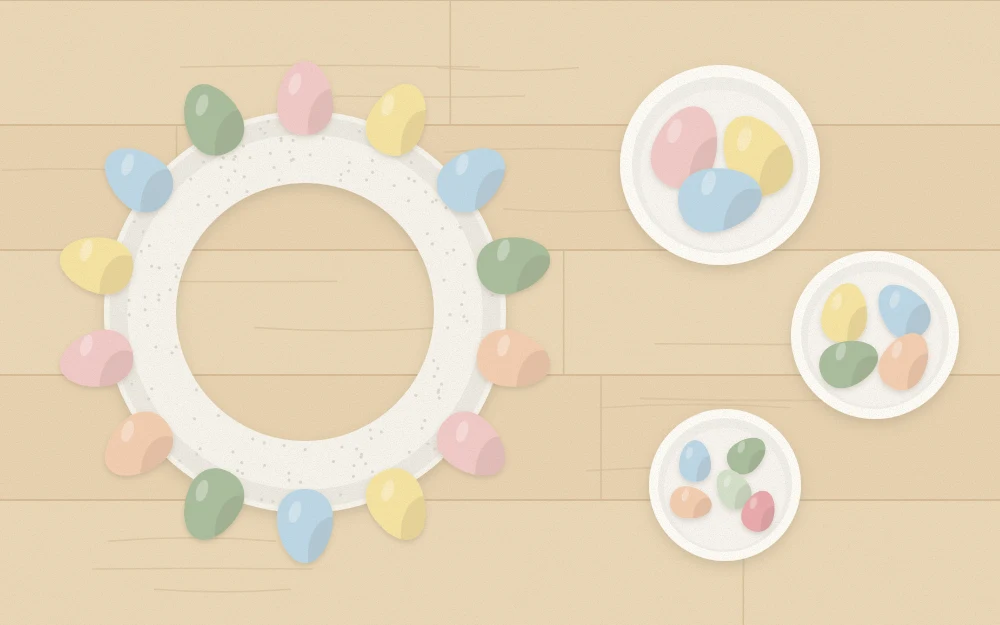
Spread the colors as you go rather than deciding at the end. A simple habit is to never place two eggs of the same color and size side by side.
Tip
Put the glue on the egg, not on the form, and hold each egg in place for a slow count of ten. Eggs that are released early tend to roll before the glue grips.
Filling gaps with moss or small leaves
Even a tightly packed ring has small dark pockets where three eggs meet. Tuck a pinch of preserved moss into each one with a dot of glue, pushing it down with a skewer rather than a fingertip. Small faux leaves, such as boxwood tips, do the same job with a neater look.
Keep the filler modest. The moss should read as shadow and texture between the eggs, not as a second material competing with them.

Once the glue has cooled, pull away any fine glue strings. A quick pass with a hair dryer on a low setting, held well back, makes them shrink and disappear.
Color and texture variations
A single-color wreath in cream or pale blue eggs looks quiet and modern, especially with speckled eggs mixed in. For a softer, more tactile ring, replace a third of the plain eggs with yarn-wrapped eggs in matching tones. They add texture without adding weight.
If a full ring of eggs feels like too much for your door, a few eggs clustered on a natural base may suit you better. The grapevine Easter wreath uses that lighter approach.
Hanging and storing the wreath
Hang the wreath by its ribbon from an over-door hanger or a removable adhesive hook rated for its weight; check the label on the hook. A covered porch is the best outdoor spot, since strong sun fades pastel plastic and summer heat can soften hot glue.
After the season, lay the wreath flat in a shallow box with tissue over the top and store it somewhere cool. Stacking anything on it will pop eggs off, so give it a box of its own.
Frequently asked questions
Can I use real blown eggshells on an egg wreath?
It is possible on a wreath that will hang on an interior wall and never be moved, but shells crack easily and a broken one is hard to replace neatly. For a door, lightweight plastic or foam craft eggs are the practical choice because they tolerate knocks and keep the wreath light.
Why do my eggs keep falling off the wreath form?
The usual causes are glue applied to a bare, crumbly foam surface, eggs released before the glue has gripped, or eggs attached at only one point. Wrap the form in ribbon first, hold each egg for about ten seconds, and glue every egg to its neighbors as well as to the form.
Can an egg wreath hang outdoors?
A covered porch or a door protected by a storm door is fine for the season. Direct sun fades pastel plastic over time and strong heat can soften hot glue, so a shaded position is better. Bring the wreath indoors in heavy wind or driving rain.