Easter Mantel Decor Ideas: How to Style a Spring Shelf
Style a mantel or shelf with handmade Easter pieces: an off-center anchor, three heights, a garland swag, groups of three and one repeated color, plus three complete example arrangements.
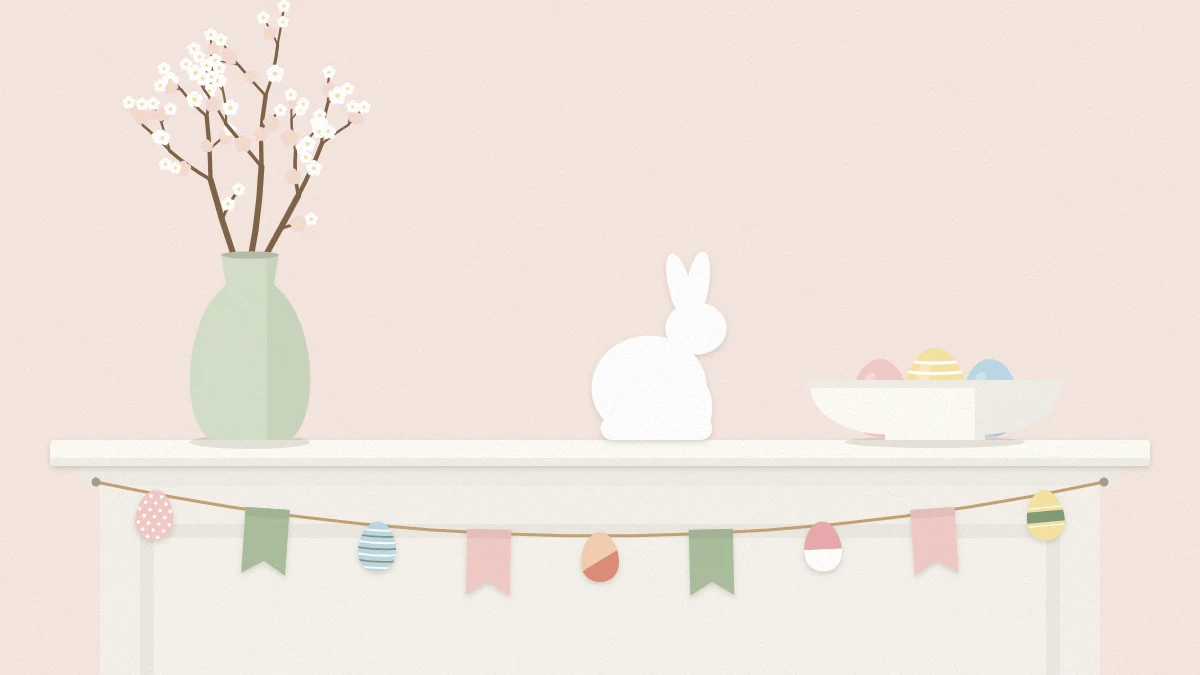
Easter mantel decor works best when it is arranged rather than accumulated. A mantel or a long shelf is a narrow stage seen from across the room, so a few handmade pieces placed with some thought will look better than a dozen lined up edge to edge.
The principles below apply to any ledge: a fireplace mantel, a console table, a bookshelf or a deep windowsill. They are followed by three complete arrangements you can copy or adapt.
Start with one anchor piece, off-center
Clear the shelf completely, then choose the largest item and place it first. This anchor might be a vase of branches, a wreath leaning against the wall, a framed print or a large pitcher of flowers. Set it about a third of the way in from one end, not in the middle. An off-center anchor gives the eye a starting point and leaves room for the rest of the arrangement to travel along the shelf.
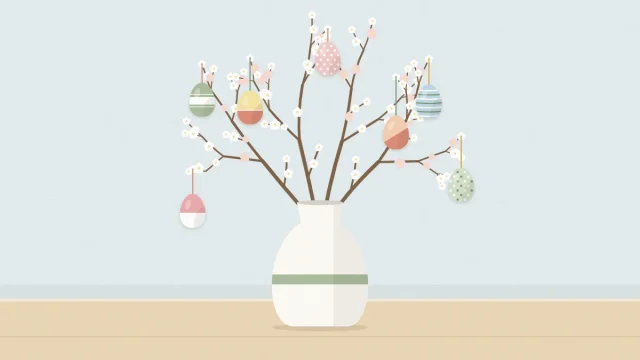
A vase of bare or flowering branches hung with a few eggs is a natural anchor for spring, and the method is covered in the guide to making an Easter tree with branches. On a mantel, keep the tree smaller and sparser than you would on a table, so it does not crowd the wall above.
Vary the heights
Objects of equal height read as a fence. Aim for three clear levels: tall, medium and low. As a rough guide, the medium pieces are about two thirds the height of the anchor and the low pieces about one third.
Let the heights step down from the anchor toward the far end of the shelf. If the arrangement feels lopsided, add one medium-height piece at the far end as a counterweight, shorter than the anchor so the two do not compete.

Stacked books, an upturned bowl or a small wooden box can lift a low object to the height you need. A bunny silhouette cut from cardstock is useful here too, because it can be made to any height.
Add a garland swag
A garland softens the hard front line of a mantel and ties the separate objects together. Hang it in one or two shallow swags along the front edge, or drape it asymmetrically so that one end trails down the side.
Measure the shelf and add about a quarter of its length again for the drape. A 5 ft (1.5 m) mantel needs a garland of roughly 6 to 6.5 ft (about 1.9 m). The paper Easter egg garland is light enough to hold with small pieces of removable mounting putty or removable adhesive hooks under the lip of the shelf, which leaves the surface unmarked.
Watch out
If the fireplace is in use, keep paper, felt, dried moss and anything that hangs below the mantel edge away from it. Use flameless LED candles on the shelf instead of lit ones.
Group in threes and leave empty space
Small objects look stronger in a cluster than spread out. Group them in threes, with one object slightly in front of the others so the group has depth: a bowl of eggs, a small jar of stems and a single egg on a stand, for example. Overlap the group a little with its neighbor so the pieces relate.
Then leave gaps. A stretch of bare shelf between groups is what lets each one be seen. A workable test is to remove one item once you think you have finished; the arrangement usually improves.
Tip
Step back to the far side of the room, or look at the mantel through half-closed eyes. The outline of heights and the spread of color become much easier to judge.
Repeat one color
Choose one accent color and make it appear at least three times along the shelf: in the eggs on the branches, in a ribbon on the garland and in a flower at the far end. Repetition is what makes handmade pieces from different projects look like a set. Keep everything else neutral, such as white, cream, wood, glass and green.
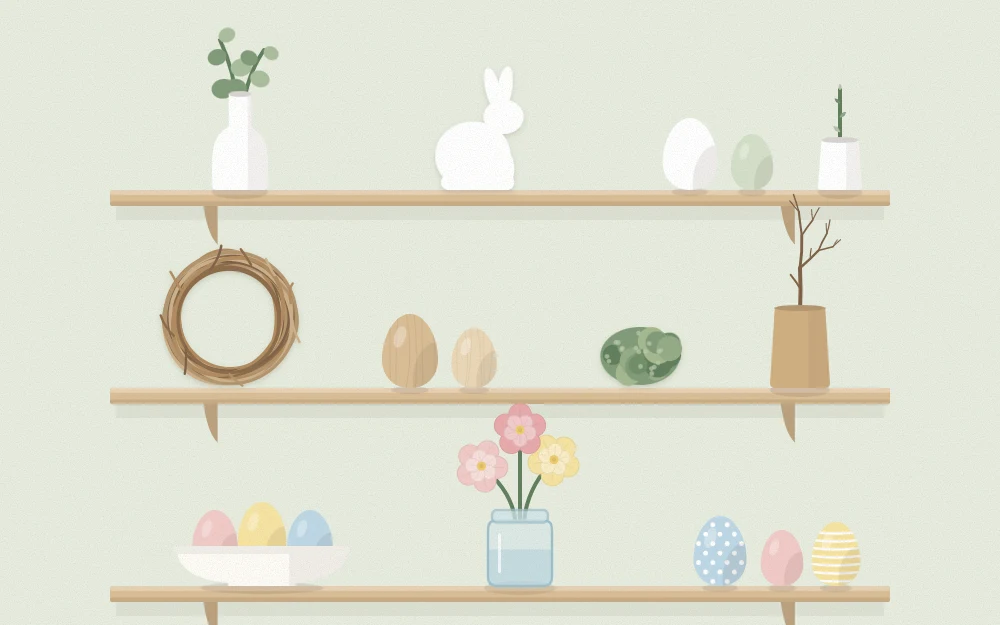
Three example arrangements
Each of these uses the same structure with different materials. The quantities suit a mantel about 5 ft (1.5 m) long; reduce them for a short shelf.
Minimal: white and green
- Anchor: a tall clear glass vase with three bare branches, left of center.
- Middle: two white bunny silhouettes of different heights leaning against the wall.
- Low: a shallow white bowl holding five plain white craft eggs.
- Repeat: green only, in a few leaves on the branches and one sprig in the bowl.
Natural: wood, moss and twine
- Anchor: a grapevine wreath leaning against the wall on the right.
- Middle: a wooden box on its side with a jar of faux greenery on top.
- Low: a bed of preserved moss with three wooden eggs and a small twig nest.
- Swag: jute twine with kraft paper eggs, draped once across the front.
Pastel: eggs and paper flowers
- Anchor: a white pitcher of faux tulips and blossom, left of center.
- Middle: a stack of two books topped with a footed dish of pastel eggs.
- Low: three small jars, each with a single paper flower.
- Swag: a paper egg garland in two shallow drapes, in the same pastels.
For the pitcher or vase in any of these, the guide to spring faux flower arrangements explains how to keep the stems loose and in proportion to the vessel.
Practical checks before you finish
- Stability. Weight tall vases with pebbles or sand, and fix light pieces with a small ball of removable mounting putty.
- Depth. Nothing should overhang the front edge, where it can be knocked in passing.
- What is above. If a mirror or picture hangs over the mantel, keep the anchor below its lower edge or clearly to one side.
- Small parts. Loose eggs and beads are best kept on higher shelves in homes with young children.
Leave the arrangement for a day and look at it again. One small move, usually closing a gap or removing a piece, is often all it needs.
Frequently asked questions
How many items should go on an Easter mantel?
There is no fixed number, but five to nine objects usually suits a mantel about 5 ft long, counting a garland as one. Think in terms of one anchor, two or three medium pieces and one or two low groups. If every object touches its neighbor, take something away.
How can a garland be hung on a mantel without nails?
Light paper and felt garlands hold well with removable adhesive hooks fixed under the lip of the shelf, or with small pieces of removable mounting putty on top. Check the weight rating on the pack. Heavier garlands can be anchored by tucking the ends under a weighted vase.
What works on a shelf that is very narrow?
Use flat or leaning pieces: paper silhouettes, a wreath propped against the wall, slim bottles with single stems and a garland along the front edge. Avoid wide bowls that overhang. Keeping to three heights and one repeated color matters even more when there is little depth to work with.