How to Make an Easter Tree with Branches and Hanging Eggs
Build a tabletop Easter tree from cut or faux branches: pick twiggy stems, weight the vase with pebbles, add hanging loops to blown, paper and felt eggs, and space them by weight.
Tutorial at a glance
Materials
- 3 to 5 cut or faux branches with side twigs
- Heavy vase with a narrow neck
- Pebbles or glass marbles
- 12 to 18 lightweight eggs
- Thin ribbon or thread and toothpicks
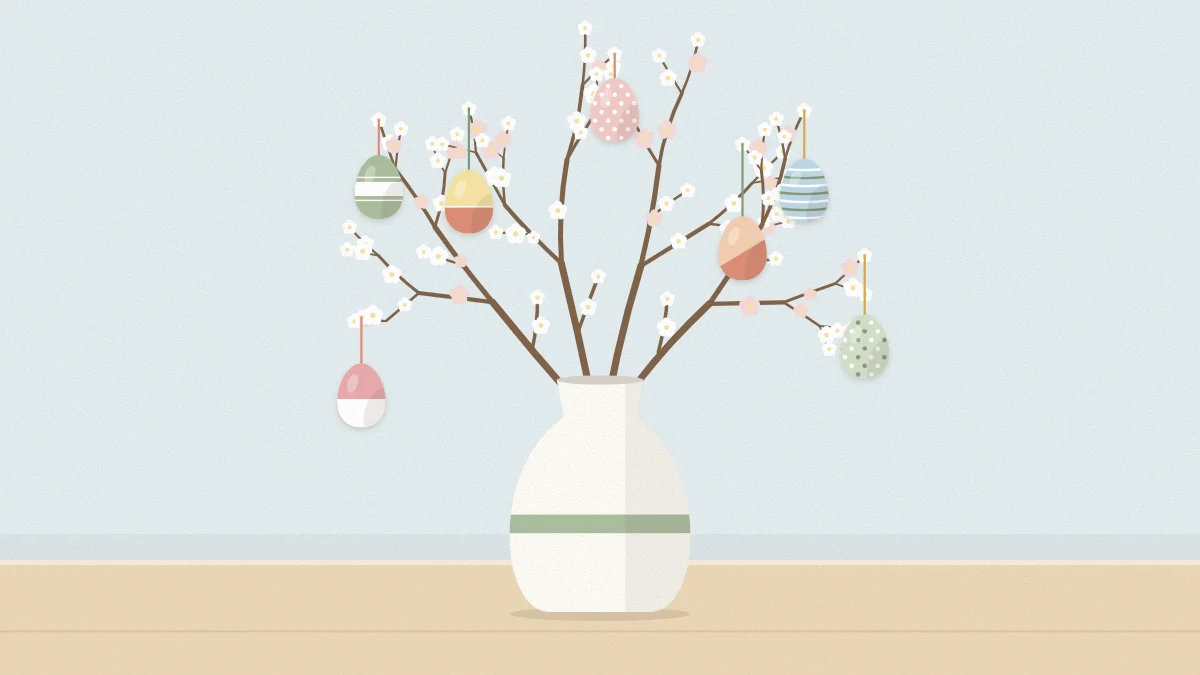
An Easter tree is one of the simplest spring displays to put together: a few bare branches in a vase, with decorated eggs hanging from the twigs. It takes up very little room, suits a sideboard or hall table, and can be added to a little each year.
The version here is a small indoor one, built in a weighted vase so that it stands firmly, with the eggs spaced so the tree looks balanced rather than crowded.
Choose Branches with Plenty of Side Twigs
The branches matter more than the vase. Look for ones with many short side twigs angled upward, because every twig is a place to hang an egg. Long, smooth whips look elegant but leave you with nowhere to put anything.
- Cut branches: pussy willow, forsythia, cherry, birch, hazel and curly willow are all good. Prunings from a garden tidy-up work well.
- Faux branches: blossom or bare-twig stems with wire cores can be bent into shape and reused every year.
- Dry painted branches: fallen twigs brushed with white acrylic craft paint give a clean, graphic look.
For a small tree, three to five branches about 24 to 30 inches (60 to 75 cm) tall is plenty. Cut them to slightly different lengths, with the tallest for the center.
Budded branches such as forsythia or cherry may open indoors if you stand them in water. Dry and faux branches need no water at all, which leaves the vase free for a heavier filler.
Weight the Vase So the Tree Stands Firm
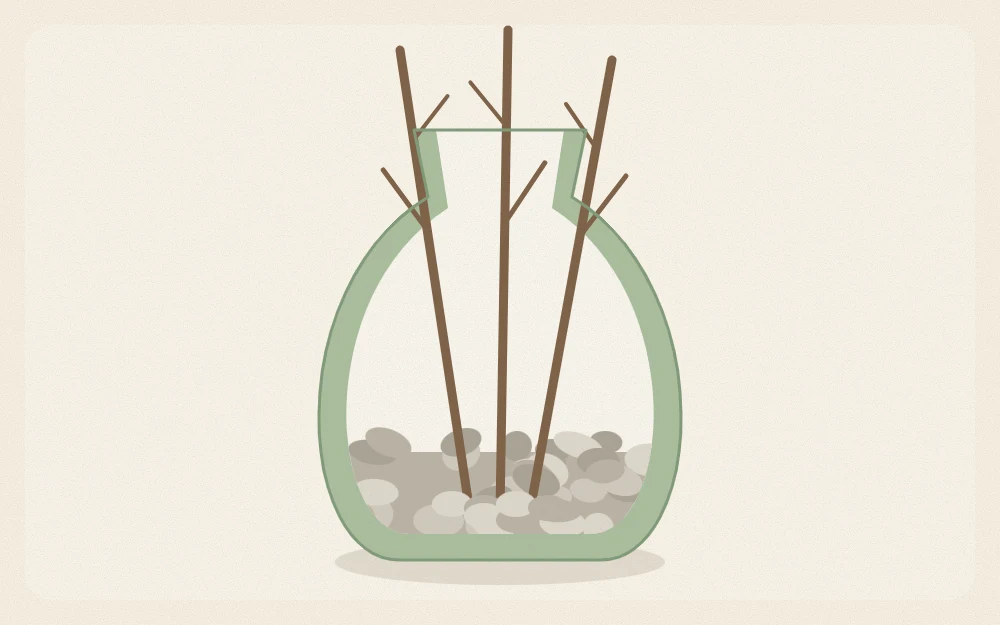
A tree hung with eggs is top-heavy. Choose a vase that is heavy for its size, such as stoneware, thick glass or a ceramic jug, with a neck narrow enough to hold the branches close together. As a guide, the vase should be about one third of the total height of the arrangement.
- Pour 2 to 3 inches (5 to 8 cm) of pebbles, glass marbles or clean aquarium gravel into the bottom of the vase.
- Push the tallest branch straight down into the pebbles at the center.
- Add the remaining branches around it, leaning each slightly outward so the tree opens like a fan.
- Top up with more pebbles until the branches no longer shift when nudged.
- If you are using fresh branches, add water now to just above the pebbles.
Turn the vase slowly and look from every side. Snip off any twigs that cross awkwardly or point straight down.
Add Hanging Loops to the Eggs
Each kind of egg needs a slightly different loop. Thin ribbon, embroidery thread or fine twine all work; cut each piece 8 to 10 inches (20 to 25 cm) long so there is enough to tie.
Blown eggs
Empty shells are the traditional choice and the lightest of all. The full method is covered in the guide on how to blow out eggs; use an egg-blowing pump or a bulb syringe rather than blowing by mouth, then rinse the shells and let them dry fully. Wash your hands, tools and work surfaces with soap and warm water after handling raw egg.
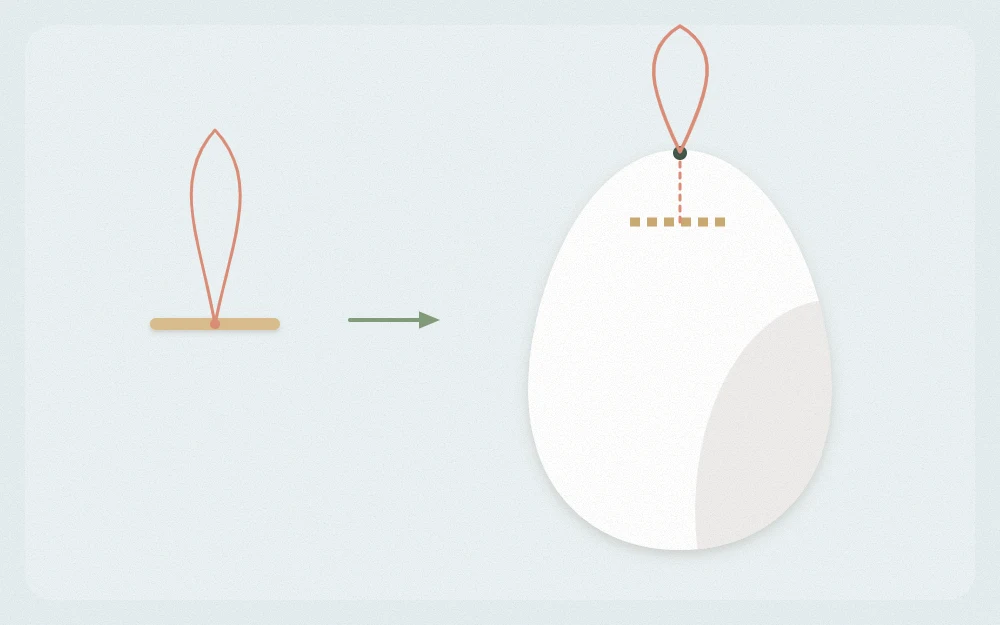
To hang a shell, break a toothpick to about 0.75 inch (2 cm) and tie the middle of your thread around its center. Hold the toothpick piece in line with the thread and slip it through the hole in the top of the egg. Once inside, it turns sideways and catches, so the egg hangs from the thread.
Watch out
Blown and decorated shells are display pieces only and are not for eating. For questions about eating or storing eggs, follow the USDA guidance on shell eggs. If you prefer not to handle raw egg, use wooden, plastic, foam or paper mache craft eggs instead.
Paper and felt eggs
Flat or folded paper egg decorations need only a small punched hole near the top and a thread knotted through it. Stitched felt Easter egg ornaments usually have a ribbon loop sewn into the seam already. Craft eggs with no hole can take a loop fixed to the top with a dot of tacky glue and a small bead or bow to cover it.
Space Ornaments by Weight
Where each egg goes depends on how heavy it is. The rule is simple: heavier low and close to the center, lighter high and toward the tips.
| Ornament | Weight | Best position |
|---|---|---|
| Wooden or ceramic eggs | Heaviest | Low, on thick twigs near the main stem |
| Stuffed felt eggs | Medium | Middle of the tree |
| Blown shells and plastic eggs | Light | Middle to upper twigs |
| Paper eggs | Lightest | Top and outer tips |
Vary the loop lengths so the eggs hang at different heights and do not knock against each other. Work around the tree in a spiral, stepping back after every few eggs.
How Many Ornaments Suit a Small Tree
For three to five branches in a tabletop vase, 12 to 18 eggs is usually right. Start with a dozen, then add one at a time until the tree looks dressed but you can still see the lines of the branches. Leaving a few twigs bare keeps it airy.
A limited palette helps as much as a limited count. Two or three colors plus white, repeated around the tree, look more composed than one egg of every shade.
Where to Stand It and How to Store It
Place the tree where it will not be brushed in passing: the back of a sideboard, a console table or a deep windowsill. Keep it away from candles and other open flames, since dry branches and paper catch easily, and out of reach of young children and pets, because blown shells are fragile and small ornaments are a hazard.
After the holiday, untie the eggs and store shells in an egg carton padded with tissue. Faux and dry branches can be wrapped in paper and kept flat for next spring.
Frequently asked questions
What branches are best for an Easter tree?
Branches with lots of short, upward-pointing side twigs give the most hanging spots. Pussy willow, forsythia, birch, hazel, cherry and curly willow are popular cut choices. Faux branches with wire cores are a good alternative because the twigs can be bent exactly where you want them and reused each spring.
How do you stop an Easter tree from tipping over?
Use a vase that is heavy for its size and fill the bottom with pebbles, marbles or gravel before adding the branches. The filler lowers the center of gravity and wedges the stems in place. Hanging the heaviest ornaments low and near the middle also keeps the weight over the base.
How many eggs should hang on a small Easter tree?
For three to five branches in a tabletop vase, around 12 to 18 eggs works well. Begin with twelve, spread them evenly, and add more one at a time. Stop while the shape of the branches is still visible, since a few bare twigs make the tree look lighter.