Paper Egg Decorations: 3D Eggs from Cardstock Strips and Slices
Two ways to build a 3D paper egg: a folded honeycomb-style egg glued spine to spine and an open strip egg held with brads or thread, with paper weights, piece counts and sizes for a tree or table.
Tutorial at a glance
Materials
- 65 lb (176 gsm) cardstock in two or three colors
- Sharp scissors and a ruler
- Glue stick or double-sided tape
- Small brads and a hole punch
- Thin thread or baker's twine
Paper egg decorations give you the rounded, sculptural look of a real egg with nothing more than cardstock, glue and a length of thread. They weigh almost nothing, so they hang from the thinnest twig, and they fold flat or nest in a box when spring is over.
Two builds cover most needs: a slotted, honeycomb-style egg made from identical egg shapes glued spine to spine, and a strip egg, where curved bands of paper are gathered at the top and bottom. Both scale easily from a tree ornament to a table piece.
Choosing paper and tools
A folded egg needs a crisp crease and thin layers, while a strip egg needs paper that holds a smooth curve.
| Build | Paper weight | Pieces | Best for |
|---|---|---|---|
| Folded egg, small | Text-weight paper or light cardstock | 10 to 12 | Branches and trees |
| Folded egg, large | 65 lb (176 gsm) cardstock | 6 to 8 | Table and shelf |
| Strip egg | 65 lb (176 gsm) cardstock | 8 to 12 strips | Hanging groups |
Besides paper you need sharp scissors, a pencil, a ruler, a glue stick or double-sided tape, a hole punch or thick needle, two small brads per strip egg, and thin thread or baker’s twine for hanging.
Pick two or three colors and repeat them across every egg rather than using a different shade for each piece. The guide to Easter color palettes has ready-made combinations if you would like a starting point.
Build one: the folded 3D egg
This egg is a stack of identical shapes, each folded down the middle and glued half to half with its neighbor. Uneven pieces show as a ragged outline, so make one cardstock template about 3 in (7.5 cm) tall and trace it for every piece. The method for drawing a balanced egg is covered in the guide to cutting symmetrical egg shapes.
- Trace and cut eight egg shapes. Stack them to check that the edges line up, and trim any that stick out.
- Fold each egg in half lengthwise, from the narrow tip to the wide end. Run a fingernail or the back of a spoon along the crease.
- Apply glue to one outer half of the first folded egg. Press the outer half of the second egg onto it, matching the folds and edges exactly.
- Repeat with the remaining pieces, always gluing one half to one half, until you have a closed stack that looks like a single folded egg.
- Cut about 10 in (25 cm) of thread, knot the ends into a loop, and lay the knot along the spine so the loop extends from the narrow tip.
- Glue the last free half to the first free half, trapping the thread inside. Fan the sections out evenly with your fingers.
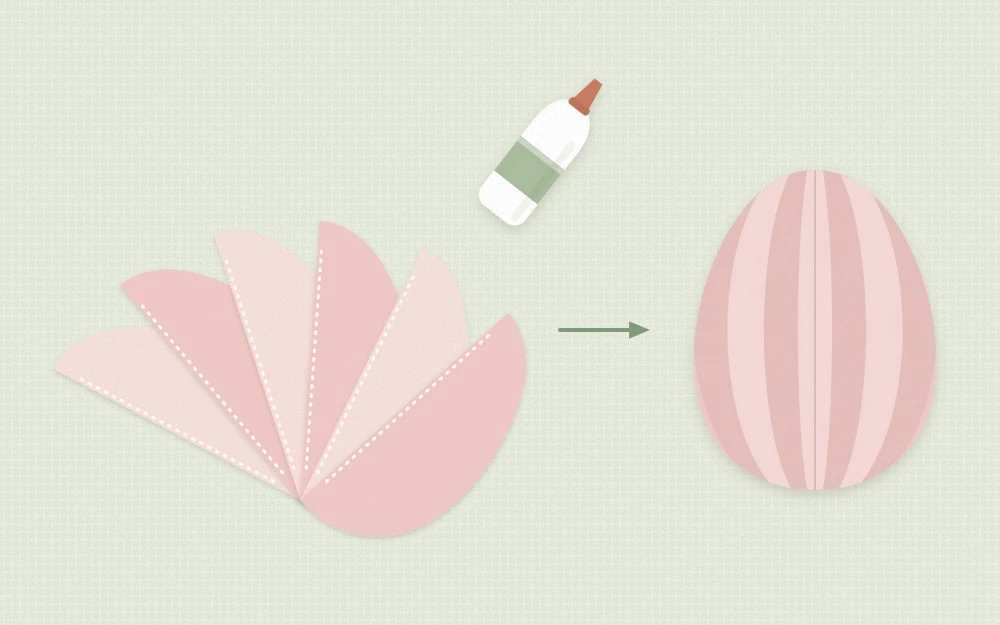
Let the glue set before hanging; check the label for the drying time. For a denser honeycomb look, use 12 to 16 pieces of lighter paper and alternate two colors.
Build two: the strip egg
The strip egg is quicker and more open. Paper bands are pinned together at each end and spread into a cage, and unequal spacing of the holes turns a plain sphere into an egg.
- Cut ten strips, each about 1/2 in (1.3 cm) wide and 7 in (18 cm) long. A paper trimmer keeps the widths even, but a ruler and scissors work well.
- Punch a small hole about 1/4 in (6 mm) from each end of every strip. Punch the stack two or three strips at a time so the holes match.
- Push a brad through the holes at one end of the whole stack and open its legs. Do the same at the other end.
- Hold the stack by both brads and push the ends gently toward each other until the strips bow outward.
- Fan the strips around the brads one by one until they are evenly spaced.
- Pinch each strip lightly about one third of the way up from the bottom. This moves the widest point down and gives the egg its shape.
- Tie a thread loop under the head of the top brad.
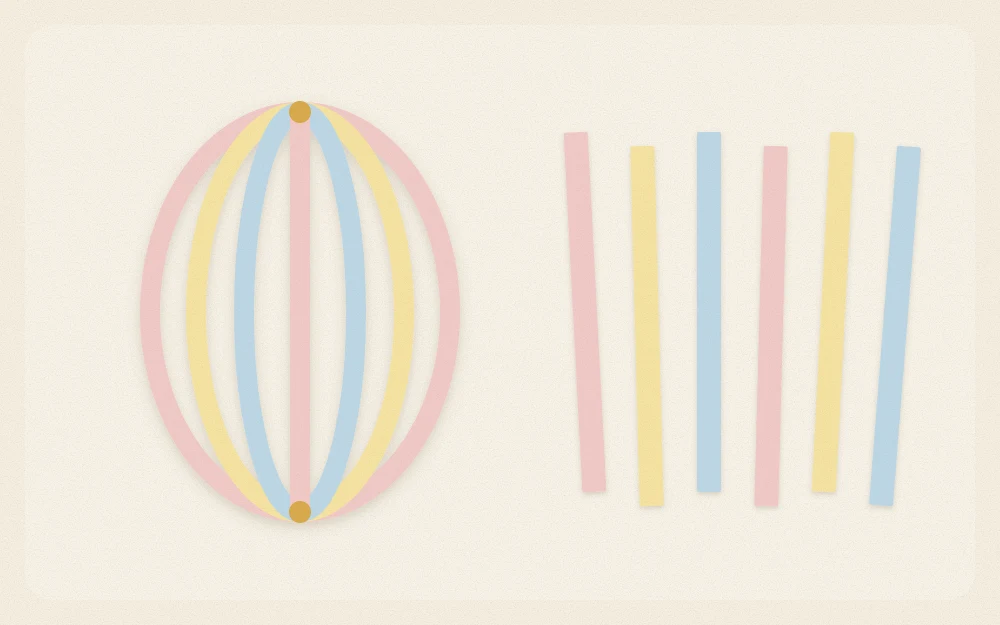
No brads on hand? Knot a small bead onto strong thread, pass the thread up through the bottom holes and out through the top holes, pull until the strips bow, then knot a second bead above the top. The leftover thread becomes the hanging loop.
Tip
Curl each strip over the edge of a ruler before assembling. Pre-curved strips bow smoothly instead of kinking in the middle.
Scaling for a table or a tree
Both builds scale by changing one measurement. For the folded egg it is the template height; for the strip egg it is the strip length, with the finished egg roughly two thirds as tall as the strips are long.
- Tree or branch: folded eggs 2 to 3 in (5 to 7.5 cm) tall, or strips about 5 in (13 cm) long. Use light paper so the twigs do not bend.
- Window or doorway: eggs 4 to 5 in (10 to 13 cm) tall hung at staggered heights.
- Table or shelf: folded eggs 6 in (15 cm) tall in 65 lb cardstock, left without a loop and set with the wide end down among greenery.
Hanging and displaying
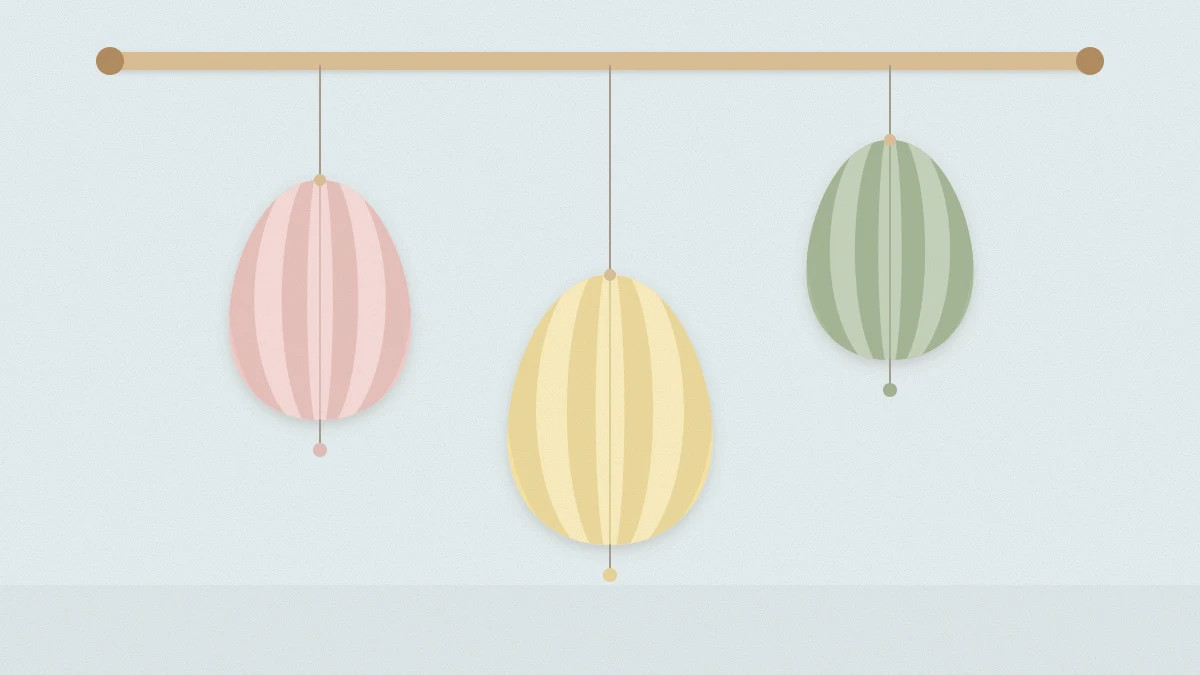
A group of three or five eggs at different heights looks more considered than a single row. Vary the thread lengths by a few inches and mix the two builds.
For a run along a wall or shelf edge, tie the loops onto a length of twine at even intervals. Flat eggs suit that job too, and the paper Easter egg garland tutorial covers spacing and stringing in detail.
Watch out
Paper decorations belong well away from candles, stove tops and other heat sources. Brads and beads are small parts, so keep them out of reach of young children.
Storing paper eggs
Folded eggs close back into a flat stack; slip each one into an envelope and keep them in a shallow box. Strip eggs flatten once the strips are gathered back into a single pile. Store both dry and away from direct sun.
Frequently asked questions
How many pieces does a 3D paper egg need?
A folded egg looks complete with six to eight pieces of cardstock, and fuller with ten to sixteen pieces of lighter paper. A strip egg needs eight to twelve strips. Fewer pieces give an airy, graphic shape, while more pieces make the egg read as a solid form from a distance.
What paper is best for 3D paper eggs?
Medium cardstock around 65 lb (176 gsm) suits strip eggs and larger folded eggs because it holds a curve and a crease. For small folded eggs with many layers, lighter paper is easier to fold and keeps the glued spine from becoming too thick to open evenly.
Why does my folded paper egg look uneven?
Uneven eggs usually come from pieces that are not identical or folds that are slightly off center. Trace every piece from one template, stack and trim them together before folding, and match the creases carefully as you glue. Fanning the sections out by hand at the end evens the spacing.